
Reformation


be-still
photo by spcbrass on flickr.com

Psalm 46 (New Revised Standard Version)
1God is our refuge and strength,
a very present help in trouble.
2Therefore we will not fear, though the earth should change,
though the mountains shake in the heart of the sea;
3though its waters roar and foam,
though the mountains tremble with its tumult.
4There is a river whose streams make glad the city of God,
the holy habitation of the Most High.
5God is in the midst of the city; it shall not be moved;
God will help it when the morning dawns.
6The nations are in an uproar, the kingdoms totter;
he utters his voice, the earth melts.
7The LORD of hosts is with us;
the God of Jacob is our refuge.
8Come, behold the works of the LORD;
see what desolations he has brought on the earth.
9He makes wars cease to the end of the earth;
he breaks the bow, and shatters the spear;
he burns the shields with fire.
10“Be still, and know that I am God!
I am exalted among the nations,
I am exalted in the earth.”
11The LORD of hosts is with us;
the God of Jacob is our refuge.

Devotional Questions from the ELCA Book of Faith Initiative:
What scares, confuses, or challenges me as I read this text?

What delights me as I read this text?

What stories or memories from my own life do I remember when I read this text?  You might choose a line or phrase to focus on that has been helpful in your own life, for example.

What do you think God is up to as you read this text?  What is God calling you to do or to be because of this story?

This is the psalm that is always appointed for Reformation Day, which we celebrate on the last Sunday in October in the ELCA Lutheran Church.  It is a day that marks the beginning of the conflict that led to the formation of the Lutheran church 499 years ago.  The founder of this movement was Martin Luther, a monk and professor who was angered by what he perceived to be abuses of the Catholic church at the time.  On October 31, 1517, he posted 95 theses, or points to argue, on the door of the Castle Church at Wittenburg, Germany.  This started a very tumultuous time for the church, and I imagine that the words of comfort in Psalm 46 became a raft to cling to for people who were trying to remain faithful to God while standing up to injustice.

What verses in this psalm speak to you?  I know from previous studies that the psalms can be intimidating at first glance.  It is often easier to break it down into verse by verse chunks, and then see what speaks to you from there.  Here are some of the verses which are speaking to me:

God is our refuge and strength, a very present help in trouble. (Psalm 46:1)

This verse is one of those that I turn to when I am in trouble.  When life seems too busy, or I have gotten over-committed, over-scheduled, or just plain overwhelmed, it is helpful to be reminded that God is not far off.  God is present here and now.  God is a place of refuge.  God is my source of strength, especially when circumstances are beyond my ability to deal with.  How has God been present in your life?  In the midst of trouble?  How has God been your refuge?  How has God worked as your source of strength?

The LORD of hosts is with us; the God of Jacob is our refuge.  (Psalm 46:7 & 11)

First, this verse reminds me that this psalm is not just for me; it is for us.  It is a communal psalm, and God’s presence is not just for me personally, but for all who call upon the name of the Lord.  We are in this together, and God comes not just to me, but to all of us.  Second, I think it is significant that this verse is repeated twice over the course of the psalm.  Usually, when I repeat something to me children, it is either because they weren’t listening the first time, or because I feel that it is important enough that I really want them to hear it.  When I carry this verse with me, it becomes a cadence to my step, repeated over and over again until its holy truth sinks deep into my soul.  How does knowing that God is the God of us change your perspective?  How might you carry this verse with you as you journey through life?

Be still, and know that I am God! (Psalm 46:10a)

This entire psalm describes a time of difficulty.  It is interesting to me that, in the midst of all of this, God’s own voice breaks in to tell us to be still.  I have used this verse fairly often as a breathing meditation when I am feeling especially frantic or frazzled.  I once saw this as a video meditation online that really stuck with me.  It began with the entire verse and then, little by little, it removed one word at a time from the end to the beginning.  The last word left was simply “Be.”  What are some ways that you cope when things are difficult?  What it is it like for you to be still? What are some times in your life when you knew for certain that God was in control?

I pray that you will carry this psalm with you as we prepare for Reformation Day at the end of the month.  May it be a blessing to you as we continue our walks of faith together.  I am looking forward to studying it with you.

In Christ,
Pastor Breen Marie Sipes
Forgiveness and Faithfulness

img_0752_m

Luke 16:1-13 (New Revised Standard Version)
1Then Jesus said to the disciples, “There was a rich man who had a manager, and charges were brought to him that this man was squandering his property. 2So he summoned him and said to him, ‘What is this that I hear about you? Give me an accounting of your management, because you cannot be my manager any longer.’ 3Then the manager said to himself, ‘What will I do, now that my master is taking the position away from me? I am not strong enough to dig, and I am ashamed to beg. 4I have decided what to do so that, when I am dismissed as manager, people may welcome me into their homes.’ 5So, summoning his master’s debtors one by one, he asked the first, ‘How much do you owe my master?’ 6He answered, ‘A hundred jugs of olive oil.’ He said to him, ‘Take your bill, sit down quickly, and make it fifty.’ 7Then he asked another, ‘And how much do you owe?’ He replied, ‘A hundred containers of wheat.’ He said to him, ‘Take your bill and make it eighty.’ 8And his master commended the dishonest manager because he had acted shrewdly; for the children of this age are more shrewd in dealing with their own generation than are the children of light. 9And I tell you, make friends for yourselves by means of dishonest wealth so that when it is gone, they may welcome you into the eternal homes.

10“Whoever is faithful in a very little is faithful also in much; and whoever is dishonest in a very little is dishonest also in much. 11If then you have not been faithful with the dishonest wealth, who will entrust to you the true riches? 12And if you have not been faithful with what belongs to another, who will give you what is your own? 13No slave can serve two masters; for a slave will either hate the one and love the other, or be devoted to the one and despise the other. You cannot serve God and wealth.”

Devotional Questions from the ELCA Book of Faith Initiative:

  • What scares, confuses, or challenges me as I read this text?
  • What delights me as I read this text?
  • What stories or memories from my own life do I remember when I read this text?  It might be a story about a time when you were surprised by forgiveness or a time when you noticed someone’s faithfulness, for example.
  • What do you think God is up to as you read this text?  What is God calling you to do or to be because of this story?

Forgiveness and faithfulness.  Faithfulness and forgiveness.  These are the concepts that resonate with me as I live with this text this month.  As Lutheran Christians, we believe that “all have sinned and fall short of the glory of God” (Romans 3:23); that’s why we begin our worship with confession and forgiveness.  We know what it is like to be forgiven, truly and completely, even when we don’t deserve it.  How have you experienced this grace in your human relationships?  Have you experienced this in your human relationships?  There are times when we sin against one another and it is hard to forgive, times when it is hard to be forgiven, but oh what grace abounds when that surprising, undeserved forgiveness finally seeps into our souls and we are free from guilt and sin once again.

I wonder if that is what Jesus is urging in the parable here.  The manager is a sinner who is in deep trouble due to dishonesty.  When he is caught, he shows the forgiveness to others that he himself wishes to experience.  Because it’s not about money, it’s about forgiveness.

Jesus then extends the discussion to faithfulness.  As I have lived with this section of the text, the refrain to the old hymn “Great is thy faithfulness” keeps running through my head:

Great is thy faithfulness!
Morning by morning new mercies I see;
All I have needed thy hand hath provided;
Great is thy faithfulness, Lord, unto me.
–#733 Evangelical Lutheran Worship

I believe that, once again, our faithfulness in action flows from the faithfulness that God shows us.  God is faithful, and trustworthy, and honorable.  God loves, forgives, and saves us, no matter what.  It is because we have a God who is so faithful that we are empowered to extend that faithfulness to others.  For some of us, that will mean doing only a few things, but doing them well.  For some of us, it will demand just about everything.

As you live with this text this month, how has God forgiven you?  How are you being called by God to forgive?  To receive forgiveness?  How has God been faithful to you?  How is God calling you to be faithful?  I am looking forward to wrestling with these questions with you this month.

In Christ, Pastor Breen Marie Sipes

Seating Chart

placecards by divingben
photo by divingben on flickr.com

Luke 14:1, 7-14 (New Revised Standard Version)

1On one occasion when Jesus was going to the house of a leader of the Pharisees to eat a meal on the sabbath, they were watching him closely.
7When he noticed how the guests chose the places of honor, he told them a parable. 8“When you are invited by someone to a wedding banquet, do not sit down at the place of honor, in case someone more distinguished than you has been invited by your host; 9and the host who invited both of you may come and say to you, ‘Give this person your place,’ and then in disgrace you would start to take the lowest place. 10But when you are invited, go and sit down at the lowest place, so that when your host comes, he may say to you, ‘Friend, move up higher’; then you will be honored in the presence of all who sit at the table with you. 11For all who exalt themselves will be humbled, and those who humble themselves will be exalted.”
12He said also to the one who had invited him, “When you give a luncheon or a dinner, do not invite your friends or your brothers or your relatives or rich neighbors, in case they may invite you in return, and you would be repaid. 13But when you give a banquet, invite the poor, the crippled, the lame, and the blind. 14And you will be blessed, because they cannot repay you, for you will be repaid at the resurrection of the righteous.”

Devotional Questions from the ELCA Book of Faith Initiative:

What scares, confuses, or challenges me as I read this text?

What delights me as I read this text?

What stories or memories from my own life do I remember when I read this text?  It might be a story about a banquet that you remember attending, for example.

What do you think God is up to as you read this text?  What is God calling you to do or to be because of this story?

I cannot remember the last time that I attended a banquet that was fancy enough for place cards.  Honestly, because my husband and I often have three young girls in tow, we are looking for a place out at the edges, preferably close to both the bathroom and the banquet table but far enough from the cake that it won’t be an irresistible temptation for little fingers.  Having what most would consider “the best spot” doesn’t even enter my mind at this point in life.

I have, however, recently been to camp, and have seen all sorts of seating preferences come into play.  The only rule at camp is that each table must have room for one adult to oversee the chaos.  However, it is interesting to sit back and watch what other “rules” become established as the week goes on.  The first rule, of course, it sitting with as many of your friends as possible.  Then comes sitting with a “fun” counselor or other adult.  If the meal occurs at lunchtime, a shady spot is preferable.  Depending on which counselor is asking the trivia questions to determine which table gets to eat next, you might choose a table full of Bible scholars, sports nuts, or Carol Joy Holling experts.  All of these rules determine where you might want to sit.

Then, there is the table that no one seems to want to sit at:  the table of outcasts.  Remember being in 6-8th grade?  Then you know the table.  This is the place where others flock until they see a certain person who they don’t like, or who it’s not cool to like, or someone who doesn’t fit in with others.  When this happens, smart people turn the other way, break up their friend groups, and sit at other tables.  After all, who wants to sit there?

Jesus makes us examine ourselves and our behavior in this month’s text, especially when it comes to seating preference.  Where do you think Jesus would be sitting at camp?  At the next wedding feast?  At your house?   Where is he calling you to sit?  Who is he calling you to choose?  How is he calling you to reach out in new ways?  I look forward to sitting and studying with you this month, as together we try to figure out the seating chart of God’s Kingdom.

In Christ, Pastor Breen

Isolation

Babylon National Museum of American History
photo by the National Museum of American History on flickr.com

 Luke 8:26-39 (New Revised Standard Version)
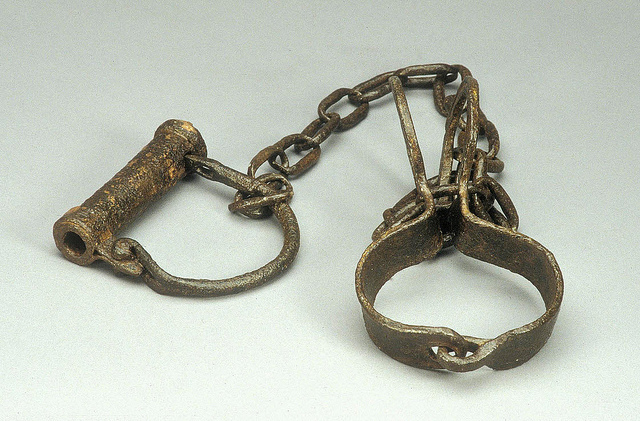
26Then [Jesus and his disciples] arrived at the country of the Gerasenes, which is opposite Galilee. 27As he stepped out on land, a man of the city who had demons met him. For a long time he had worn no clothes, and he did not live in a house but in the tombs. 28When he saw Jesus, he fell down before him and shouted at the top of his voice, “What have you to do with me, Jesus, Son of the Most High God? I beg you, do not torment me”—29for Jesus had commanded the unclean spirit to come out of the man. (For many times it had seized him; he was kept under guard and bound with chains and shackles, but he would break the bonds and be driven by the demon into the wilds.)30Jesus then asked him, “What is your name?” He said, “Legion”; for many demons had entered him. 31They begged him not to order them to go back into the abyss.
32Now there on the hillside a large herd of swine was feeding; and the demons begged Jesus to let them enter these. So he gave them permission. 33Then the demons came out of the man and entered the swine, and the herd rushed down the steep bank into the lake and was drowned.
34When the swineherds saw what had happened, they ran off and told it in the city and in the country. 35Then people came out to see what had happened, and when they came to Jesus, they found the man from whom the demons had gone sitting at the feet of Jesus, clothed and in his right mind. And they were afraid. 36Those who had seen it told them how the one who had been possessed by demons had been healed. 37Then all the people of the surrounding country of the Gerasenes asked Jesus to leave them; for they were seized with great fear. So he got into the boat and returned. 38The man from whom the demons had gone begged that he might be with him; but Jesus sent him away, saying, 39“Return to your home, and declare how much God has done for you.” So he went away, proclaiming throughout the city how much Jesus had done for him.

ELCA Book of Faith Initiative Devotional Questions:

What scares, confuses, or challenges me in this text?

What delights me in this text?

What stories or memories does this text stir up in me?  You might remember a time that you were afraid when something turned out in a way that you didn’t expect, for example.

What is God up to in this text?

As I read this text this month, I have a hard time truly getting into the shoes of the man known as the Geresene demoniac.  I have felt like an outsider at certain times in my life, sure; I was not always picked first in gym or asked to sing the solo at the concert.  However, to be so out of your mind that you are forced to live, not in a house, but in the graveyard?  I cannot imagine what that kind of isolation must be like.  And yet, I know that it continues to happen, even to this day.  There are those who do suffer from mental illness, treated or untreated.  There are those who are imprisoned, who are either considered such a threat or under such a threat from fellow inmates, that they spend long days in isolation.  Some people who have been diagnosed with terminal illnesses such as cancer have also shared with me the isolation that they felt from this diagnosis, when the community “doesn’t want to bother” them in their time of difficulty, and then no one calls or visits or offers to help.

Jesus comes into this Geresene community and sees both a suffering person and a suffering community.  What is surprising to me it that he heals the person and then sends that person to heal the community.  The man is healed, returned to his right mind, and no longer needs to be isolated.  However, the community doesn’t know what to do.  The man, fearing that there will never be a proper place for him there, and perhaps remembering just how he had been treated over the years of his suffering, wants to flee.  He wants to cling to Jesus, the source of his healing, the source of his new hope.  Jesus, however, has other plans.

Did you notice the reaction of the community?  It is not joy but fear.  We hear about the dead herd of swine, but it is seeing the healed man in his right mind that causes the reaction of fear.  What are they afraid of?  Maybe they don’t like a challenge to the status quo.  Maybe they don’t want to reorder their community to include one who was always on the margins.  Whatever it is, it scares them enough that they ask Jesus to leave.  Are they afraid he will spread more healing around?  That their world might be turned upside down by more of his presence?  They might not be so far from wrong.

And maybe that’s why Jesus calls the man to be his missionary in his own hometown.  Jesus submits to the demands of the community, but insists that the healed man stay, return to his home, and “declare how much God has done for you.”  This might be a new call to isolation for him.  In declaring Good News to those who are afraid, might he not continue to suffer as an outsider?  Or perhaps he is the perfect one for this job.  He knows what it is like to be on the outside.  He knows what it is like to be healed by Jesus.  It is the story of his life, and only he is truly qualified to offer it up as a testimony to others again and again, as long as it takes for fear to melt into wonder, and wonder into thanksgiving, and thanksgiving into hope.

Where do you find yourself in this story?  How is God speaking to you about the last, the least, and the lost?  About fear?  About community?  I look forward to our discussions together as a parish in the coming month.

In Christ, Pastor Breen

Speak the Word

centurion
photo by Amgueddfa Cymru- National Museum Wales on flickr.com

Luke 7:1-10 (New Revised Standard Version)
1After Jesus had finished all his sayings in the hearing of the people, he entered Capernaum. 2A centurion there had a slave whom he valued highly, and who was ill and close to death. 3When he heard about Jesus, he sent some Jewish elders to him, asking him to come and heal his slave. 4When they came to Jesus, they appealed to him earnestly, saying, “He is worthy of having you do this for him, 5for he loves our people, and it is he who built our synagogue for us.” 6And Jesus went with them, but when he was not far from the house, the centurion sent friends to say to him, “Lord, do not trouble yourself, for I am not worthy to have you come under my roof; 7therefore I did not presume to come to you. But only speak the word, and let my servant be healed. 8For I also am a man set under authority, with soldiers under me; and I say to one, ‘Go,’ and he goes, and to another, ‘Come,’ and he comes, and to my slave, ‘Do this,’ and the slave does it.” 9When Jesus heard this he was amazed at him, and turning to the crowd that followed him, he said, “I tell you, not even in Israel have I found such faith.” 10When those who had been sent returned to the house, they found the slave in good health.

ELCA Book of Faith Initiative Devotional Questions:

What scares, confuses, or challenges me in this text?

What delights me in this text?

What stories or memories does this text stir up in me?  You might remember a time that you prayed for healing, or asked someone with more authority than you for a favor, for example.

What is God up to in this text?

I’m not sure that I like the centurion.  I know that it is in part because of the year and country that I live in, but something about the phrase “a slave whom he valued highly” rubs me the wrong way.  Then there is the way that he talks to Jesus, like he and Jesus are a part of a good old boys club, and that membership earns him a little healing.  To me, he is quite unlikable.

However, once I start to take a few of the other details in this story seriously, my opinion starts to change.  Here is a centurion, a Roman commander, who has worked to help Jews to build a place of worship.  Here is a man in authority who is willing to clear his schedule to help a slave.  Here is a person who humbles himself, who submits himself to Jesus’ authority, because he knows that he can’t solve this problem, and he believes that Jesus can.

I also have to take into account Jesus’ opinion here.  He exclaims, “Not even in Israel have I found such faith.”  What am I missing?  What makes this guy so faithful?  What makes Jesus do what he asks?  I look forward to wrestling with these and other questions with you this month as we dwell in the Word in Bible study.  “Only speak the word, and let my servant be healed.”  What a remarkable profession of faith!

In Christ, Pastor Breen

The Lord’s My Shepherd

shepherd

Dwelling in the Word:  April 2016

Psalm 23:  King James Version (KJV)
The Lord is my shepherd; I shall not want.
He maketh me to lie down in green pastures:
he leadeth me beside the still waters.
He restoreth my soul:
he leadeth me in the paths of righteousness
for his name’s sake.
Yea, though I walk
through the valley of the shadow of death,
I will fear no evil:
for thou art with me;
thy rod and thy staff they comfort me.
Thou preparest a table before me
in the presence of mine enemies:
thou anointest my head with oil;
my cup runneth over.
Surely goodness and mercy shall follow me all
the days of my life:
and I will dwell in the house of the Lord forever.

ELCA Book of Faith Initiative Devotional Questions:
What scares, confuses, or challenges me in this text?

What delights me in this text?

What stories or memories does this text stir up in me?

What is God up to in this text?

This month’s article comes from Dr. James Limburg, Professor Emeritus of Old Testament at Luther Seminary.  This article can be found online at https://www.workingpreacher.org/preaching.aspx?commentary_id=919

Feet

Feet

Dwelling in the Word:  March 2016

John 13:1-17, 31b-35 (New Revised Standard Version)
1Now before the festival of the Passover, Jesus knew that his hour had come to depart from this world and go to the Father. Having loved his own who were in the world, he loved them to the end. 2The devil had already put it into the heart of Judas son of Simon Iscariot to betray him. And during supper 3Jesus, knowing that the Father had given all things into his hands, and that he had come from God and was going to God, 4got up from the table, took off his outer robe, and tied a towel around himself. 5Then he poured water into a basin and began to wash the disciples’ feet and to wipe them with the towel that was tied around him.6He came to Simon Peter, who said to him, “Lord, are you going to wash my feet?” 7Jesus answered, “You do not know now what I am doing, but later you will understand.” 8Peter said to him, “You will never wash my feet.” Jesus answered, “Unless I wash you, you have no share with me.” 9Simon Peter said to him, “Lord, not my feet only but also my hands and my head!” 10Jesus said to him, “One who has bathed does not need to wash, except for the feet, but is entirely clean. And you are clean, though not all of you.” 11For he knew who was to betray him; for this reason he said, “Not all of you are clean.”
12After he had washed their feet, had put on his robe, and had returned to the table, he said to them, “Do you know what I have done to you? 13You call me Teacher and Lord—and you are right, for that is what I am. 14So if I, your Lord and Teacher, have washed your feet, you also ought to wash one another’s feet. 15For I have set you an example, that you also should do as I have done to you. 16Very truly, I tell you, servants are not greater than their master, nor are messengers greater than the one who sent them. 17If you know these things, you are blessed if you do them.”

ELCA Book of Faith Initiative Devotional Reading Questions:

What scares, confuses, or challenges me in this text?

What delights me in this text?

What stories or memories does this text stir up in me?

What is God up to in this text?

How do you feel about feet?  It is my experience that people feel very strongly about them.  Feet smell bad.  They are not pretty.  They are meant for walking on and forgetting about, unless, of course, something is wrong with them.  Then, we hide them or treat them in secret or pay a professional to do so.  It is no wonder, then that in this story, many of us will identify with Peter.  Jesus, his Lord and Teacher, is kneeling at the feet of his friends, lower than the average house slave, and washing their dirty feet!  Yuck!  No thanks!  It’s bad enough that we have to scrub them so we don’t get the bed dirty at night, but having someone we admire, look up to, want to be when we grow up, examine, hold, wash our feet?  No way!

But here’s the deal.  There is not a hair on our heads that Jesus finds to be unlovely.  He loves every part of us, from the hair on our heads (or not!), to the mole between our shoulder blades, to the toe jam between the toes of our feet.   Those parts that we want to hide, or forget about, or ignore, Jesus loves completely.  He loves us for who we are, for who we were made to be, in all of our imperfections.  He loves enough to get down on his knees, to act as our servants, to show us how much he loves and how to love one another.  We may protest, but Jesus demands that we get with the program, surrender to his love, and show his love to a world badly in need of this particular unconditional flavor of it.

Last year at our Maundy Thursday service, my children’s sermon was about Jesus washing his disciples’ feet.  I was wholly surprised when, as I talked, several of our children began eagerly removing their shoes in the full expectation of having their feet washed by me.  I was flabbergasted.  I was amazed.  And I was completely unprepared.  I thought that talking about Jesus’ actions would remind them that we were called to be servants to one another, and they were ready to experience it for themselves.  I remember turning to the adults of the congregation and saying, “I guess I know what I am doing next year!”  What a wonderful surprise from those with the most exciting faith among us!

This year, I will offer foot washing on Maundy Thursday during the children’s message.  And I will ask them to wash my feet, as well.  I have washed hundreds of feet during my ministry, and I am especially looking forward to the faces of our young ones as they experience it for themselves.  May their actions, and reactions, be a witness to us of Jesus’ unending love and care and compassion.  Maybe, just maybe, they will change us big people’s hearts and minds towards feet!  Miracles, after all, do happen…

In Christ, Pastor Breen

The Main Thing: Dwelling in the Word February 2016

got milk?

Isaiah 55:1-9 (New Revised Standard Version)

1Ho, everyone who thirsts,
come to the waters;
and you that have no money,
come, buy and eat!
Come, buy wine and milk
without money and without price.
2Why do you spend your money for that which is not bread,
and your labor for that which does not satisfy?
Listen carefully to me, and eat what is good,
and delight yourselves in rich food.
3Incline your ear, and come to me;
listen, so that you may live.
I will make with you an everlasting covenant,
my steadfast, sure love for David.
4See, I made him a witness to the peoples,
a leader and commander for the peoples.
5See, you shall call nations that you do not know,
and nations that do not know you shall run to you,
because of the Lord your God, the Holy One of Israel,
for he has glorified you.

6Seek the Lord while he may be found,
call upon him while he is near;
7let the wicked forsake their way,
and the unrighteous their thoughts;
let them return to the Lord, that he may have mercy on them,
and to our God, for he will abundantly pardon.
8For my thoughts are not your thoughts,
nor are your ways my ways, says the Lord.
9For as the heavens are higher than the earth,
so are my ways higher than your ways
and my thoughts than your thoughts.

This month I have chosen this song from Isaiah for our parish to study because it resonates with me.  Like most prophetic writing, it is a message from God to the people, and, even though we hear it several thousand years after it was written, as God’s continuing people in this world, it is written directly to us.  The two verses which are working on me this month are verses 2 and 9:  “Why do you spend your money for that which is not bread, and your labor for that which does not satisfy?” and “For as the heavens are higher than the earth, so are my ways higher than your ways and my thoughts than your thoughts.”

Verse 2 is a question that I need to hear from time to time, especially addressed straight from God’s lips to my ears.  We live in a culture that values busyness and more, More, MORE!  It is good to be reminded that this might not be God’s value, and, in fact, that it isn’t God’s value.  Busyness doesn’t save us; having more stuff doesn’t save us.  God alone does that work, and this verse reminds me “to keep the main thing the main thing” (Stephen Covey).  What do I spend my money on that is bread?  What do I spend my money on that is not?  What about my labor is satisfying?  What about my labor is not?  How do I better align my life to God’s goals?  And so the questions breed more questions, questions which I hope lead me “in paths of righteousness for his name’s sake” (Psalm 23).

Verse 9 puts me in my place, especially as we anticipate the cross-shaped journey of Lent.  If “Who is God?” is the question this verse poses, “Not I” is the answer that I need to hear.  In being reminded that God is God and I am not, it gives me both a feeling of awe and a feeling of comfort.  I am not alone in my journey, and the God who goes with me every step of the way knows all, feels all, loves all, and protects all.  God’s eye is on the sparrow and all of creation at once.  God knows my thoughts and knows so much more than I could ever conceive.   And I am in God’s hands with all the saints in heaven and on earth from now until the day after eternity.

Finally, it with this realization of my dependence that I can return to the beginning of the song and hear it is an invitation instead of a handout:  “1Ho, everyone who thirsts, come to the waters; and you that have no money, come, buy and eat! Come, buy wine and milk without money and without price.”  Without God, I am thirsty.  Without God, I am hungry.  Without God, I am tired and weak, and worn.  Without God, I have nothing to celebrate and nothing to live for.  With God, my thirst is quenched, my stomach is full, my faith is renewed, and my cup is overflowing, and this song, written for me and for all God’s people, serves not only to remind and correct, but also to refill and restore.

By this time we read this passage in church, almost half of our Lenten journey will have elapsed.  I am looking forward with eager anticipation to this wonderful rest stop in scripture along the way.  Thanks be to God.  Amen.

In Christ, Pastor Breen

At Home in the Manger?:  Dwelling in the Word January 2016

at the edge

Luke 4:21-30 (New Revised Standard Version)
21Then [Jesus] began to say to [all in the synagogue in Nazareth,] “Today this scripture has been fulfilled in your hearing.” 22All spoke well of him and were amazed at the gracious words that came from his mouth. They said, “Is not this Joseph’s son?” 23He said to them, “Doubtless you will quote to me this proverb, ‘Doctor, cure yourself!’ And you will say, ‘Do here also in your hometown the things that we have heard you did at Capernaum.’ ” 24And he said, “Truly I tell you, no prophet is accepted in the prophet’s hometown. 25But the truth is, there were many widows in Israel in the time of Elijah, when the heaven was shut up three years and six months, and there was a severe famine over all the land; 26yet Elijah was sent to none of them except to a widow at Zarephath in Sidon. 27There were also many lepers in Israel in the time of the prophet Elisha, and none of them was cleansed except Naaman the Syrian.” 28When they heard this, all in the synagogue were filled with rage. 29They got up, drove him out of the town, and led him to the brow of the hill on which their town was built, so that they might hurl him off the cliff. 30But he passed through the midst of them and went on his way.

ELCA Book of Faith Initiative Devotional Questions:

What scares, confuses, or challenges me in this text?

What delights me in this text?

What stories or memories does this text stir up in me?  You might remember a time when all spoke well of you, or it was difficult to be in your own hometown, for example.

What is God up to in this text?

Sometimes, I think time goes faster the older I get.  It was just a few days ago that we were gathered at the manger, worshipping the newborn king Jesus, and in this text he is all grown up and causing trouble.  I wonder if that’s why we like Christmas so much.  In the movie Talladega Nights, Ricky Bobby prays a table grace to the “Dear Sweet Baby Jesus.”  He uses this title so often during the prayer that his wife interrupts him to remind him that Jesus grew up into a man.  “I know,” Ricky Bobby says, “but I like the Christmas Jesus best.”  I hear what he is saying, even as I wonder why that is.  Do we like Christmas Jesus best because he is a baby?  Because he is weak and small and in danger, and we can connect with that?  Do we resist the grown-up Jesus because he won’t stay inside our box, or do what we expect, or make us feel warm and comfortable?

It seems to be that way in this month’s text.  Jesus comes home and reads scripture in the synagogue, his home church.  He does such a “nice” job that everyone speaks well of him.  This is the baby, the boy, the nice young man that they remember growing up in their town.  He fits into their expectations, he’s just like he used to be.  The recognize him, and are proud that he represents their town to the world.

But then he opens his mouth to interpret what he has just read.  He reminds them that prophets and hometowns don’t get along, because the Word of the Lord is rarely comfortable, it is convicting. Furthermore, it is almost impossible to hear words that are difficult from someone you used to know.  The mood of the crowd sours.  Hearing these difficult words cause the crowd to do just as Jesus predicted, and they turn from praise to violence.  And Jesus gets out of town, his hometown, in a hurry, in fear of his life.

What are some ways in which you try to keep Jesus in the manger and out of the business of your life?  Who have you put in a pigeonhole and refused to let grow up because you were afraid of how your opinion of them might have to change?  How is Jesus coming to you in the messiness and imperfection of your own life?  As we celebrate together the season of the Epiphany and the bringing of the Word to the nations, I pray that Jesus might just complicate your life, stir you to action, and love you through the tough spots.  Thanks be to God.  Amen.

In Christ, Pastor Breen

Lo How a Rose: A Christmas Devotion

lo how a rose

Last week, the parish that I serve celebrated Christmas Lessons and Carols.  The hymn “Lo, How a Rose,” which is the story of Mary, has stuck with me ever since.  In the story of Jesus’ birth, I always identify most strongly with Mary.  Her faith and willingness to change her whole life to make a place of Jesus always amaze me.  Here is a devotion that I developed for the WELCA Christmas Parties that I am attending for my parish this year.

You can find it in PDF format here:
Christmas Devotion Lo How a Rose

Items Needed:
Copies of the hymn for everyone
a rose in a bud vase
figurines from a nativity set:  Mary, Angel, Joseph, Shepherd, Jesus
candle, candle holder, and matches

Sing verse 1 (Lutheran Book of Worship)

Karaoke Version Here:  https://youtu.be/ifxnAXzyxFU

(Add a rose to the centerpiece)

Isaiah 11:1-5 (NRSV)

A shoot shall come out from the stump of Jesse,
and a branch shall grow out of his roots.
The spirit of the Lord shall rest on him,
the spirit of wisdom and understanding,
the spirit of counsel and might,
the spirit of knowledge and the fear of the Lord.
His delight shall be in the fear of the Lord.

He shall not judge by what his eyes see,
or decide by what his ears hear;
but with righteousness he shall judge the poor,
and decide with equity for the meek of the earth;
he shall strike the earth with the rod of his mouth,
and with the breath of his lips he shall kill the wicked.
Righteousness shall be the belt around his waist,
and faithfulness the belt around his loins.

Sing Verse 2

(Add Mary and the Angel to the centerpiece)

Luke 1:26-38

26 In the sixth month the angel Gabriel was sent by God to a town in Galilee called Nazareth, 27 to a virgin engaged to a man whose name was Joseph, of the house of David. The virgin’s name was Mary. 28 And he came to her and said, “Greetings, favored one! The Lord is with you.” 29 But she was much perplexed by his words and pondered what sort of greeting this might be.30 The angel said to her, “Do not be afraid, Mary, for you have found favor with God. 31 And now, you will conceive in your womb and bear a son, and you will name him Jesus. 32 He will be great, and will be called the Son of the Most High, and the Lord God will give to him the throne of his ancestor David. 33 He will reign over the house of Jacob forever, and of his kingdom there will be no end.” 34 Mary said to the angel, “How can this be, since I am a virgin?” 35 The angel said to her, “The Holy Spirit will come upon you, and the power of the Most High will overshadow you; therefore the child to be born will be holy; he will be called Son of God. 36 And now, your relative Elizabeth in her old age has also conceived a son; and this is the sixth month for her who was said to be barren. 37 For nothing will be impossible with God.” 38 Then Mary said, “Here am I, the servant of the Lord; let it be with me according to your word.” Then the angel departed from her.

Sing Verse 3

(Add Joseph and the Shepherds to the centerpiece)

Luke 2:1-20

In those days a decree went out from Emperor Augustus that all the world should be registered. This was the first registration and was taken while Quirinius was governor of Syria. All went to their own towns to be registered.Joseph also went from the town of Nazareth in Galilee to Judea, to the city of David called Bethlehem, because he was descended from the house and family of David. He went to be registered with Mary, to whom he was engaged and who was expecting a child. While they were there, the time came for her to deliver her child. And she gave birth to her firstborn son and wrapped him in bands of cloth, and laid him in a manger, because there was no place for them in the inn.

In that region there were shepherds living in the fields, keeping watch over their flock by night. Then an angel of the Lord stood before them, and the glory of the Lord shone around them, and they were terrified. 10 But the angel said to them, “Do not be afraid; for see—I am bringing you good news of great joy for all the people: 11 to you is born this day in the city of David a Savior, who is the Messiah, the Lord. 12 This will be a sign for you: you will find a child wrapped in bands of cloth and lying in a manger.” 13 And suddenly there was with the angel a multitude of the heavenly host, praising God and saying,

14 “Glory to God in the highest heaven,
and on earth peace among those whom he favors!”

15 When the angels had left them and gone into heaven, the shepherds said to one another, “Let us go now to Bethlehem and see this thing that has taken place, which the Lord has made known to us.” 16 So they went with haste and found Mary and Joseph, and the child lying in the manger. 17 When they saw this, they made known what had been told them about this child; 18 and all who heard it were amazed at what the shepherds told them. 19 But Mary treasured all these words and pondered them in her heart. 20 The shepherds returned, glorifying and praising God for all they had heard and seen, as it had been told them.

Sing verse 4

(Add a candle to the centerpiece.)

John 1:1-5

In the beginning was the Word, and the Word was with God, and the Word was God. He was in the beginning with God. All things came into being through him, and without him not one thing came into being. What has come into being in him was life, and the life was the light of all people. The light shines in the darkness, and the darkness did not overcome it.

Sing Verse 5

(Light the candle and add Jesus to the centerpiece.)

John 1:10-14 

 He was in the world, and the world came into being through him; yet the world did not know him. 11 He came to what was his own, and his own people did not accept him. 12 But to all who received him, who believed in his name, he gave power to become children of God, 13 who were born, not of blood or of the will of the flesh or of the will of man, but of God.

14 And the Word became flesh and lived among us, and we have seen his glory, the glory as of a father’s only son, full of grace and truth.

Listen to “Lo, How a Rose” by Alex Stephens

God bless your Advent preparations!