Laborers

godswork by splcwaukegan.jpg

Gospel: Matthew 9:35–10:23 New Revised Standard Version

35Jesus went about all the cities and villages, teaching in their synagogues, and proclaiming the good news of the kingdom, and curing every disease and every sickness. 36When he saw the crowds, he had compassion for them, because they were harassed and helpless, like sheep without a shepherd. 37Then he said to his disciples, “The harvest is plentiful, but the laborers are few; 38therefore ask the Lord of the harvest to send out laborers into his harvest.”
10:1Then Jesus summoned his twelve disciples and gave them authority over unclean spirits, to cast them out, and to cure every disease and every sickness. 2These are the names of the twelve apostles: first, Simon, also known as Peter, and his brother Andrew; James son of Zebedee, and his brother John; 3Philip and Bartholomew; Thomas and Matthew the tax collector; James son of Alphaeus, and Thaddaeus; 4Simon the Cananaean, and Judas Iscariot, the one who betrayed him.
5These twelve Jesus sent out with the following instructions: “Go nowhere among the Gentiles, and enter no town of the Samaritans, 6but go rather to the lost sheep of the house of Israel. 7As you go, proclaim the good news, ‘The kingdom of heaven has come near.’ 8Cure the sick, raise the dead, cleanse the lepers, cast out demons. You received without payment; give without payment. 9Take no gold, or silver, or copper in your belts, 10no bag for your journey, or two tunics, or sandals, or a staff; for laborers deserve their food. 11Whatever town or village you enter, find out who in it is worthy, and stay there until you leave. 12As you enter the house, greet it. 13If the house is worthy, let your peace come upon it; but if it is not worthy, let your peace return to you. 14If anyone will not welcome you or listen to your words, shake off the dust from your feet as you leave that house or town. 15Truly I tell you, it will be more tolerable for the land of Sodom and Gomorrah on the day of judgment than for that town.
16“See, I am sending you out like sheep into the midst of wolves; so be wise as serpents and innocent as doves. 17Beware of them, for they will hand you over to councils and flog you in their synagogues; 18and you will be dragged before governors and kings because of me, as a testimony to them and the Gentiles. 19When they hand you over, do not worry about how you are to speak or what you are to say; for what you are to say will be given to you at that time; 20for it is not you who speak, but the Spirit of your Father speaking through you. 21Brother will betray brother to death, and a father his child, and children will rise against parents and have them put to death; 22and you will be hated by all because of my name. But the one who endures to the end will be saved. 23When they persecute you in one town, flee to the next; for truly I tell you, you will not have gone through all the towns of Israel before the Son of Man comes.”

Devotional Questions from the ELCA’s Book of Faith Initiative:

What scares, confuses, or challenges me in this text?  What do I have questions about?

What delights me in this text?  What do I like about it?

What stories or memories does this text stir up in me?  You might remember a time when you had to use your “street smarts” more than your “book learning,” for example.

What is God up to in this text?  What is God calling you to do or to be because of this story?

As I have read this text in preparation for this Bible study this month, verses 37-38 keep leaping out at me:

Then [Jesus] said to his disciples, “The harvest is plentiful, but the laborers are few; therefore ask the Lord of the harvest to send out laborers into his harvest.”

Perhaps it’s because these are verses that were read at my ordination service, where I was made into a pastor.  The preacher that day reminded us that pastors are laborers sent out into the harvest of faithful people whom God has prepared.  More than likely, though, it’s because of the new statistic that our Nebraska Synod bishop, Brian Maas, keeps repeating these days, “This year, we will have an 800 pastor shortage based on available calls and available pastors.  In two years, we will be short by 1,000 pastors.”  This is a bit terrifying.  How are congregations going to keep fulfilling the mission that God is calling them to without qualified leaders to assist them?  How are pastors going to keep from burning out as they are asked to take on more and more duties?  Will we return to the circuit riding days of the frontier?  How will we manage all of this change?

I hope you haven’t stopped reading; I know there is enough bad news everywhere these days that you don’t really need more from me.  The thing is, we are Lutherans, and Lutherans are able to look at things from multiple perspectives and, rather than succumbing to fear and despair, we seek to find the ray of hope, asking, “Where is God in all of this?”

Part of the answer to this question is prayer.  In March, the ELCA Conference of Bishops passed this resolution:  “As the Conference of Bishops, we call our worshiping communities to pray for raising up leaders for this church. We ask that the petitions of every worship service include a plea that new lay leaders, deacons and pastors be identified, invited, encouraged and supported in responding to God’s call to ministry.”  We can pray for God to open up the eyes, ears, and hearts of those who are gifted with the leadership qualities to hear God’s call to become pastors, deacons, and lay leaders.  I ask you to consider adding this concern to your personal prayers in the days to come, as well.

Another answer comes from our Presiding Bishop, Elizabeth Eaton.  She has begun a new leadership inititiave across the ELCA.  You can find out more about it here:  www.elca.org/leaders This initiative “intends to inspire ELCA leaders to seek out and encourage gifted people in their congregations, communities and networks to consider a call to the ministry of the gospel, supported by growing levels of scholarships for seminary tuition.”  Who in your life is a person who you believe might be one who needs to answer the call to church leadership?  Have you told them?  Have you asked them how you can support them?  Have you lifted them up in prayer, or considered setting aside a gift to help one of our own become a pastor or deacon?  If your answer is “not yet,” I urge you to consider that there is no better time than now, when the need is clearly so great.

A final answer comes a little closer to home.  This problem might seem far away; after all, you have a full-time called pastor with children who has set down roots in the community and feels both energized and at home among you.  I invite you to consider your own leadership roles within our parish, and consider how God might be calling you to leadership in a new way.  Are you already a leader?  Thanks be to God for you!  Have you served as a leader in the past, but now wish to “pass the baton” to a new generation of leaders?  How are you providing mentorship, teaching, and encouragement to that new generation?  Have you asked them “how’s it going” or “what can I do to support you” lately?  Are you uncertain where to start, but you love your church, and would be willing to step into unknown territory to help it grow and thrive?  Please take all of these questions to God in prayer in the coming days; I will also pray for you.

In Christ,
Pastor Breen Sipes

Food for the Journey

conversation by valery kenski
Image by Valery Kenski on flickr.com

Above all else, guard your heart,
for everything you do flows from it.
(Proverbs 4:23 NIV)

Now when Daniel learned that the decree had been published, he went home to his upstairs room where the windows opened toward Jerusalem. Three times a day he got down on his knees and prayed, giving thanks to his God, just as he had done before.
(Daniel 6:10 NIV)

These are two of the verses that our confirmands have chosen for their Bible verses when they get confirmed at the end of this month.  They chose these verses themselves, and I am excited to work with them over the next month to really embed these verses into their hearts and minds so that they are able to take them with them “when they are at home and when they are away, when they lie down and when they rise.”  As I was considering these verses, I began to wonder how the Bible in embedded into your life of faith.

What was your confirmation verse?  How has it served you in your life of faith? 

If you didn’t have one or can’t remember it, what do you wish your confirmation verse had been?  Why?

What is your favorite Bible story or verse in the current moment?  You don’t have to remember the chapter or verse, but do share the high points here:

Why is this story or verse your favorite?  How does it serve you in your life of faith?

Do you know what stories or verses are the favorites of your spouse, children, or parents?  If so, jot them down here:

Why are they favorites?  How do they serve your loved ones in their lives of faith?

As I study with you this month, I am planning to collect all of these favorites into a gift for our confirmands: “Tri-Saints Food for the Journey.”  I am looking forward to listening to your stories and sharing them with those who will really love to hear them. If you do not regularly study with me over the course of the month and would like to contribute to this project, write me a note, an email, a text, or FB message.  Let’s give these new adults in the faith a great foundation on which to build.

In Christ,
Pastor Breen Sipes

Lips of Children

hosanna by carbonnyc.jpg

Matthew 21:1-11 (New Revised Standard Version)
1When they had come near Jerusalem and had reached Bethphage, at the Mount of Olives, Jesus sent two disciples, 2saying to them, “Go into the village ahead of you, and immediately you will find a donkey tied, and a colt with her; untie them and bring them to me. 3If anyone says anything to you, just say this, ‘The Lord needs them.’ And he will send them immediately.” 4This took place to fulfill what had been spoken through the prophet, saying,
5“Tell the daughter of Zion,
Look, your king is coming to you,
humble, and mounted on a donkey,
and on a colt, the foal of a donkey.”
6The disciples went and did as Jesus had directed them; 7they brought the donkey and the colt, and put their cloaks on them, and he sat on them. 8A very large crowd spread their cloaks on the road, and others cut branches from the trees and spread them on the road. 9The crowds that went ahead of him and that followed were shouting,
“Hosanna to the Son of David!
Blessed is the one who comes in the name of the Lord!
Hosanna in the highest heaven!”
10When he entered Jerusalem, the whole city was in turmoil, asking, “Who is this?” 11The crowds were saying, “This is the prophet Jesus from Nazareth in Galilee.”

ELCA Book of Faith Devotional Questions:

What scares, confuses, or challenges me in this text?  What leaves me scratching my head?

What delights me in this text?  What do I like about it?

What stories or memories does this text stir up in me?  You might remember a time when you borrowed something from someone or attended a parade, for example.

What is God up to in this text?  What is God calling me to do or to be in this text?

When I was a kid, I couldn’t wait for Palm Sunday.  The opportunity to dress up, almost in my Easter best, to wave palm branches as we paraded around the church, and to sing a song I was convinced was written just for us:

All glory, laud, and honor,
to you, redeemer, king,
To whom the lips of children
Made sweet hosannas ring!  (LBW #108)

I truly loved this holiday, because we, the children of the congregation, were actually mentioned.  And in song!  You know how the saying goes, “From the mouths of babes!”.  On Palm Sunday, the children of God got it right.  Jesus shows up as a humble king, and the crowd responds by literally taking the coats off of their backs, spreading branches from nearby trees on the ground, and joining in the parade.  They shout “Hosanna to the Son of David!” which literally means “Save us, Lord, king of David’s line!”  They called him blessed, and say he comes in the name of the Lord.  When the people of the city gather in confusion, the crowd tells them that he is “the prophet Jesus from Nazareth in Galilee.”  On this day, on this one day, they get it right.

The problem with Palm Sunday is that we celebrate Jesus as king while also knowing what awaits him during Holy Week.  The crowd believes that he will take his place on the literal throne of Israel, cast the Roman government out, and the people of God will be ruled on earth once again by a wise, powerful, Jewish king.  Instead, Jesus, the Son of God, comes among us to bring about the kingdom of God.  He kneels at the feet of his friends like the lowliest slave.  He offers them his body as true bread and his blood as true drink.  He commands them to love one another as he prepares to go to a place where no one can follow.  He is betrayed and arrested.  He is tried in two separate courtrooms.  He is mocked and beaten.  And then the crowd shows up again.

This time, they get it horribly wrong.  This time, their cry is not “Save us!” or “Blessed is the one who comes in the name of the Lord!” but rather “Crucify him!” and “His blood be on us and on our children” and “Crucify him!”  And Jesus, the Son of David, the Son of God, the true king, is nailed to a cross, lifted up between two criminals for all to see, and dies.

If nothing else, Holy Week is a stark reminder of what life is like.  There are times when our faith is strong and we do, indeed turn to God in prayer.  There are times when we clap, and celebrate, and just can’t keep from singing.  And there are times when we walk through the valley of the shadow of death, and question our faith, and refuse to admit that we belong to him.

But the truth is, Jesus is right there with us, no matter what.  In the best of times.  In the worst of times.  And in every time in between.  Loving us.  Forgiving us.  Saving us.  No matter what.  For, as Paul writes:

“For I am convinced that neither death, nor life, nor angels, nor rulers, nor things present, nor things to come, nor powers, 39 nor height, nor depth, nor anything else in all creation, will be able to separate us from the love of God in Christ Jesus our Lord.” (Romans 8:38-39 NRSV)

That, my friends, is why Holy Week is so very holy.  We are faithless, but he is faithful.  We get it right, and Jesus is there.  We get it wrong, and Jesus is there.  We work to kill what is truly holy, and God raises it from the dead.  I look forward to walking with through through life, and death, into new life once again.  See you in church,

In Christ,
Pastor Breen

Identity

cliff

Matthew 4:1-11 (New Revised Standard Version)
1Jesus was led up by the Spirit into the wilderness to be tempted by the devil. 2He fasted forty days and forty nights, and afterwards he was famished. 3The tempter came and said to him, “If you are the Son of God, command these stones to become loaves of bread.” 4But he answered, “It is written,
‘One does not live by bread alone,
but by every word that comes from the mouth of God.’ ”
5Then the devil took him to the holy city and placed him on the pinnacle of the temple, 6saying to him, “If you are the Son of God, throw yourself down; for it is written,
‘He will command his angels concerning you,’
and ‘On their hands they will bear you up,
so that you will not dash your foot against a stone.’ ”
7Jesus said to him, “Again it is written, ‘Do not put the Lord your God to the test.’ ”
8Again, the devil took him to a very high mountain and showed him all the kingdoms of the world and their splendor; 9and he said to him, “All these I will give you, if you will fall down and worship me.” 10Jesus said to him, “Away with you, Satan! for it is written,
‘Worship the Lord your God,
and serve only him.’ ”
11Then the devil left him, and suddenly angels came and waited on him.

ELCA Book of Faith Devotional Questions:

  1. What scares, confuses, or challenges me in this text?  What leaves me scratching my head?
  2. What delights me in this text?  What do I like about it?
  3. What stories or memories does this text stir up in me?  You might remember a time when you took a trip far from home, or felt tempted, for example.
  4. What is God up to in this text?  What is God calling me to do or to be in this text?

The season of Epiphany always begins with the Baptism of our Lord.  Jesus comes to the river and is baptized by his cousin, John, and the heavens open up and the Spirit comes down and a voice from heaven says, “This is my Son, the Beloved, with whom I am well pleased.”  After this Epiphany event, we in the church move on to the teachings of Jesus for several weeks.  To me, this is a bit unfortunate because, in skipping ahead in the story, we neglect to realize what happens next.

The season of Lent begins with the story of the Temptation of Jesus.  And it is what happens directly after Jesus’ baptism.  The thing that happens directly after his baptism, practically in the next moment, is this: “Jesus was led up by the Spirit into the wilderness to be tempted by the devil.  He fasted forty days and forty nights, and afterwards he was famished.”  Jesus goes from affirmation to temptation, from new life to the struggle against death.  From certainty to uncertainty.

And the devil knows it.  Remember what God said about Jesus in his baptism?  “This is my Son, the Beloved, with whom I am well pleased.”  God claims Jesus as his Son.  God gives Jesus unconditional love.  God affirms his choice, and his full favor.  And after forty days and nights in the wilderness, what does the devil attack?  Jesus’ identity.  “If you are the Son of God…” begins two of the devil’s three main temptations.  He challenges Jesus at the level of identity, and intends to make him question just who he is.

When we enter into the season of Lent, we also take a lot of time to examine our own identities as children of God.  We may even intentionally put temptation into our own way in the forms of fasting, giving of alms, and works of love.  It is a season for the baptized, for those who have already been “sealed by the Holy Spirit and marked with the cross of Christ forever.” We are God’s beloved children, with whom he is well pleased, but this does not remove temptation from our lives.  In fact, it might even intensify it.  I truly believe that the devil works harder against those of us who are attempting to follow Jesus than those who might have already gone another way.  Because what if we succeed?  What if the kingdom of God, indeed, comes among us?

Jesus knows who he is and whose he is.  He is able to vanquish the devil and come out of the wilderness to preach the word and bring healing and hope to the widow, the outcast, and the orphan.  He comes out of the wilderness and sets his face to the cross, to the work that he came to earth to do for us.  Because he loves us.  And forgives us.  And makes us his.

We all wander in the wilderness at one point or another in our lives, and Lent is the time in the church when we fully acknowledge it. As we enter this season, may your Lenten journey confirm your identity as a beloved child of God.  I look forward to traveling with you on the way.

In Christ, Pastor Breen Marie Sipes

Do Not Enter

do-not-enter-openclipart-org

Matthew 5:21-37 (New Revised Standard Version)

[Jesus said to the disciples:] 21“You have heard that it was said to those of ancient times, ‘You shall not murder’; and ‘whoever murders shall be liable to judgment.’ 22But I say to you that if you are angry with a brother or sister, you will be liable to judgment; and if you insult a brother or sister, you will be liable to the council; and if you say, ‘You fool,’ you will be liable to the hell of fire. 23So when you are offering your gift at the altar, if you remember that your brother or sister has something against you, 24leave your gift there before the altar and go; first be reconciled to your brother or sister, and then come and offer your gift. 25Come to terms quickly with your accuser while you are on the way to court with him, or your accuser may hand you over to the judge, and the judge to the guard, and you will be thrown into prison. 26Truly I tell you, you will never get out until you have paid the last penny.
27“You have heard that it was said, ‘You shall not commit adultery.’ 28But I say to you that everyone who looks at a woman with lust has already committed adultery with her in his heart. 29If your right eye causes you to sin, tear it out and throw it away; it is better for you to lose one of your members than for your whole body to be thrown into hell. 30And if your right hand causes you to sin, cut it off and throw it away; it is better for you to lose one of your members than for your whole body to go into hell.
31“It was also said, ‘Whoever divorces his wife, let him give her a certificate of divorce.’ 32But I say to you that anyone who divorces his wife, except on the ground of unchastity, causes her to commit adultery; and whoever marries a divorced woman commits adultery.
33“Again, you have heard that it was said to those of ancient times, ‘You shall not swear falsely, but carry out the vows you have made to the Lord.’ 34But I say to you, Do not swear at all, either by heaven, for it is the throne of God, 35or by the earth, for it is his footstool, or by Jerusalem, for it is the city of the great King. 36And do not swear by your head, for you cannot make one hair white or black. 37Let your word be ‘Yes, Yes’ or ‘No, No’; anything more than this comes from the evil one.”

ELCA Book of Faith Devotional Questions:

What scares, confuses, or challenges me in this text?  What leaves me scratching my head?

What delights me in this text?  What do I like about it?

What stories or memories does this text stir up in me?  You might remember a time when you held a grudge, or failed to be “perfect” in a specific way, for example.

What is God up to in this text?  What is God calling me to do or to be in this text?

This month’s text is definitely a tough one.  Most of us believe that we are, basically, good people, and, if we act good and decently, God will love us and forgive us and take us to heaven one day.  We look at the Ten Commandments, and feel that as long as we aren’t praying to foreign gods, haven’t actually murdered anyone, and haven’t cheated on our spouses lately, that we are keeping the law and are in God’s favor.  This text, however, leaves no wiggle room.  Jesus not only reminds us of the law, but intensifies it to the point where no one can wriggle out from underneath its condemnation.  Have you ever been angry at someone?  You have broken God’s law.  Have you ever found someone who was not your spouse attractive?  You have broken God’s law.  Have you ever said to someone who doubted the truth of what you had to say, “I swear!”?  You have broken God’s law.  Yikes!  Ouch!  Where’s the hope?  What is the purpose of condemnation after condemnation after condemnation?

In Romans 2:22b-24, Paul writes: “For there is no distinction, since all have sinned and fall short of the glory of God; they are now justified by his grace as a gift, through the redemption that is in Christ Jesus.”  All of us are sinners.  All of us mess up.  No one human being on earth is truly and completely holy.  We are all in the same boat.  This is a good reminder for us, as the people of God.  The purpose of the Sermon on the Mount, of which this text is a part, is to remind those who are already the saved children of the heavenly Father just why we need saving.  The purpose of the Sermon on the Mount is to remind us that we are no better or worse than anyone else, no matter how much we would like it to be true.  We all need saving.  We all need love.  We all need forgiveness.  We all need grace.  The purpose of the Sermon on the Mount is to turn us again to God, who is the source of our life, and our health, and our healing.  God is the source of everything good, and without God, we amount to nothing.

So, how are you doing?  In the midst of this bad news, this unflattering mirror, this breakdown of all the myths we tell ourselves about being good, and right, and true, where do we stand?  For me, maybe the answer is that I don’t.  Instead, I fall on my knees, confess my sin, and rejoice in the free grace poured out as a gift.  And, just maybe, when I open my eyes and look around at my neighbors, I look with less condemnation and more grace.  I look with less judgement and more love.  I look with less building myself up and more building up of the broken, who need to see Jesus in me, now more than ever.

You are a beloved child of God.  And you are a sinner.  And so am I.  I look forward to dwelling more deeply in this Word with you this month, and the wonderful conversations that this will spark.  You are in my thoughts and prayers.

In Christ, Pastor Breen

Beloved

baptism-by-llengot
photo by llengot on flickr.com

Matthew 3:13-17 (New Revised Standard Version)

13 Then Jesus came from Galilee to John at the Jordan, to be baptized by him. 14 John would have prevented him, saying, “I need to be baptized by you, and do you come to me?” 15 But Jesus answered him, “Let it be so now; for it is proper for us in this way to fulfill all righteousness.” Then he consented. 16 And when Jesus had been baptized, just as he came up from the water, suddenly the heavens were opened to him and he saw the Spirit of God descending like a dove and alighting on him. 17 And a voice from heaven said, “This is my Son, the Beloved, with whom I am well pleased.”

Book of Faith Devotional Questions:

  1. What scares, confuses, or challenges me in this text?
  1. What delights me in this text?
  1. What stories or memories does this text stir up in me?
  1. What is God up to in this text?

Dear brothers and sisters in Christ, grace to you and peace, from God our Father and our Lord and Savior, Jesus Christ. Amen.

“This is my Son, the Beloved, with whom I am well pleased.” (Matthew 3:17 NRSV)

These are the words that God the Father uses to describe Jesus at the event of his baptism in the Jordan River by his cousin, John. The thing that always amazes me about this description is that Jesus hasn’t done anything yet! He was born, he grew up, and he lived, but he hasn’t yet begun his ministry for God on earth. He hasn’t yet set his face towards the cross. And yet, Jesus is God’s Son. God loves Jesus. And God is well pleased, even before he begins to do anything worth writing down.

We received this same promise on the day that we were baptized:

“You are my child, the Beloved, with whom I am well pleased.”

Once again, this description is a gift. For many of us, who were baptized as infants, it is just as much of a miracle as when God said it about Jesus. We hadn’t done anything yet. We hadn’t made anything, or produced anything, or contributed monetarily to society in any way. And yet. And yet. In baptism, we are God’s sons and daughters. In baptism, we assured that God loves us all the time, no matter what. In baptism, we begin our ministry on this earth knowing that, even without our actions, with us God is well pleased.

What implications does this have for us in ministry together as Tri-Saints Lutheran Parish in Byron and Hardy, Nebraska in the year of our Lord 2017? Because we are children of God, our lives are grounded in this identity. We are God’s, first, last, and always. Because we are Beloved, our lives reach out in love. We live by the greatest commandment, and love God and one another with all our hearts, and minds, and souls, and strength. Because God is well pleased with us, our lives so forth God’s mercy and grace and compassion. We give each other the benefit of the doubt, and, as Luther’s meaning of the 8th commandment says, “we come to [our neighbor’s] defense, speak well of them, and interpret everything they do in the best possible light” (ELW pg. 1161). In baptism, our lives are changed in an indelible way, and our attitudes towards God and the world are different. Here are some of the ways I see our parish living out their baptismal callings here and now and in this place:

Children of God
I thank God for all of those in our parish who are faithful in seeing that the work of the church is accomplished, day after day, week after week, and year after year. Please take some time to thank those who serve on the council, worship and music, and parish education committees of your church. They work hard as children of God to create meaningful spaces, worship, and educational experiences for all of our saints. Without their leadership, we would not be the witness that we are in our communities.

Beloved
I thank God for all of those in our parish who have been willing to use their hands and feet to show forth God’s love in the community in the world. This year, I especially thank the continuing work of the LWR quilts and kits, the NICU sheets, the Little Shorts for Africa project, and the Soles for Hope shoes. We have also prepared boxes for Operation Christmas Child and, through the work of God’s Work, Our Hands Sunday, painted the park in Hardy, made fleece hats for foster children in Nebraska, and collected school supplies for an elementary school in Donna, TX. This parish takes the command to reach out in love seriously, and I am so thankful to partner with you in this way.

God is Well Pleased
Finally, I thank God for all of you, who faithfully attend worship and Bible study, who give to mission and ministry of the church, who visit our sick and shut-in, and who show forth Christ in so many little ways every day. I know for certain that, when we are at our best, God is more than well pleased with the work and witness of our parish. It is just who we are. As Paul exhorts in II Thessalonians 3:13:

“Brothers and sisters, do not be weary in doing what is right.”

Our baptismal calling is not always easy, but it is holy. As we enter into this new year, how can you live more fully into this calling? How is God calling you to be his child? How are you be sent to love and serve your neighbor? Which gifts and talents can you more fully engage on behalf of God, secure in the knowledge that he is already well pleased with you? I hope that you will take the time to seek God’s will in these matters, and talk with me if you are either stuck or inspired. I rejoice to journey with you on this road of faith.

Thanks be to God for all of you. I am looking forward to discovering what God is calling us to in the coming year.

In Christ,
Pastor Breen

Follow the Star

Advent 2016 week 4.png

Matthew 2:1-12 (New Revised Standard Version)
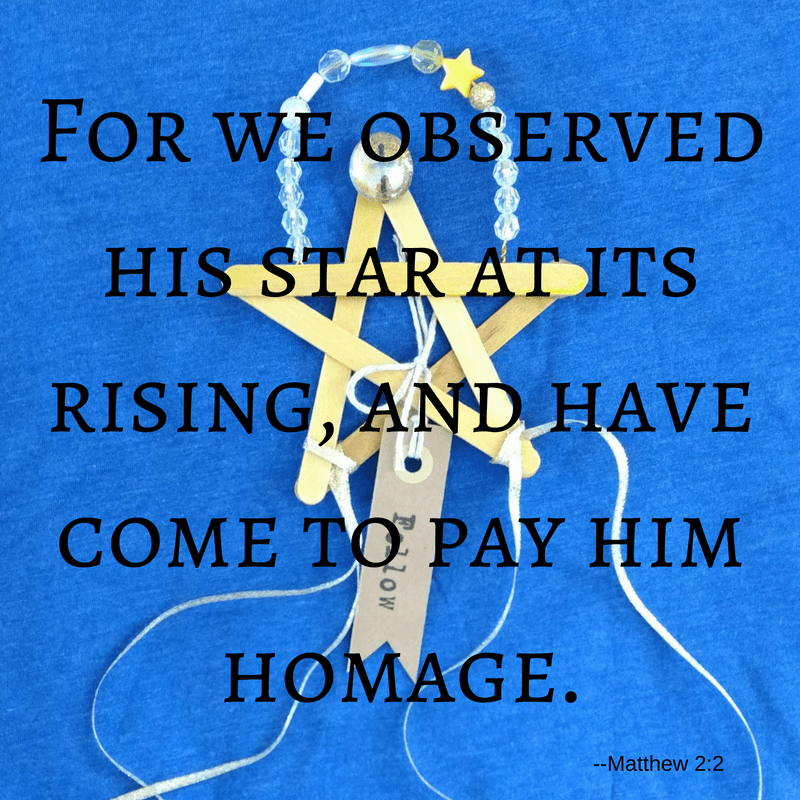
In the time of King Herod, after Jesus was born in Bethlehem of Judea, wise men from the East came to Jerusalem, asking, “Where is the child who has been born king of the Jews? For we observed his star at its rising, and have come to pay him homage.” When King Herod heard this, he was frightened, and all Jerusalem with him; and calling together all the chief priests and scribes of the people, he inquired of them where the Messiah was to be born. They told him, “In Bethlehem of Judea; for so it has been written by the prophet:
‘And you, Bethlehem, in the land of Judah,
are by no means least among the rulers of Judah;
for from you shall come a ruler
who is to shepherd my people Israel.’ ”
Then Herod secretly called for the wise men and learned from them the exact time when the star had appeared. Then he sent them to Bethlehem, saying, “Go and search diligently for the child; and when you have found him, bring me word so that I may also go and pay him homage.” When they had heard the king, they set out; and there, ahead of them, went the star that they had seen at its rising, until it stopped over the place where the child was. 10 When they saw that the star had stopped, they were overwhelmed with joy. 11 On entering the house, they saw the child with Mary his mother; and they knelt down and paid him homage. Then, opening their treasure chests, they offered him gifts of gold, frankincense, and myrrh. 12 And having been warned in a dream not to return to Herod, they left for their own country by another road.

Devotional Questions from the ELCA Book of Faith Initiative:

What scares, confuses, or challenges me as I read this text?

What delights me as I read this text?

What stories or memories from my own life do I remember when I read this text? 

What do you think God is up to as you read this text?  What is God calling you to do or to be because of this story?

“Where is the child who has been born king of the Jews?  For we observed his star at its rising, and have come to pay him homage” (Matthew 2:2).  During the Advent season, the theme for the worship of the parish has been this verse.  With the children, we have watched the star rise as we waited for Jesus to come among us.  Now, with the advent of Jesus’ birth on Christmas, we have arrived with the wise men to see the new baby king.  It is not surprising that the wise men weren’t exactly sure where to go; after all, they were looking for a king.  They went first to the most obvious place:  a palace.  Little did they know that their questions would lead to fear, and fear to weapons, and weapons to the slaughter of all the male children in Bethlehem, in an effort to contain the threat.

Whatever the circumstances, their footsteps finally led to Bethlehem.  I love this line in the story: “When they saw that the star had stopped, the were overwhelmed with joy” (Matthew 2:10).  Why were they joyful?  What were they expecting?  Were they glad to finally be at the end of a long journey?  Had it begun to feel like a wild goose chase with no payoff at all?  Or were their hearts full to bursting at this once in history event, that they were about to witness for themselves?

Whatever the source of their joy, their footsteps led to a house, and in the house a child and his mother, and in the child the salvation of the world.  The wise men knew this; it is reflected in the gifts that they brought to honor him.  Gold, for a king.  Frankincense, to worship him as God.  Myrrh, to prepare him, even now, to die to save us.  Precious gifts.  Lovely gifts.  An act of worship from foreign believers who had the faith to cross the entire world to see him for themselves.

And then, once the wrapping paper was set aside, the wise men dusted off their knees, turned around, and went home.  By another road.  To give Jesus and Mary and Joseph just enough time to get away before the army showed up.  By another road.  So they could tell the story of their marvelous journey to a whole new audience, and the word would begin to spread, not when Jesus was grown up and ready to take on the tasks of his ministry, but when he was just a child, fleeing for his life, a vulnerable human creature with a ruler bent on his extinction.

Where is the road to Jesus leading you?  Where are you on the journey?  What gifts can you bring to honor him in your life and your work, in your relationships and your Sabbath time?  God bless you on your journey!

In Christ, Pastor Breen

Reflections for the New Year

new-year-17-header001

Today, we stand on the cusp of a new year. Plato said, “An unexamined life is not worth living,” and, in many ways, I tend to agree.  How are we able to see God working in our lives if we never stop and reflect?  This new year’s eve is a perfect time to do so.

I have developed two resources to aid you in this exercise.  The first is for adults and youth, and the second is for youth and children.  I hope that you will find them useful to you as we embark on the new adventure of 2017.

New Year Reflection Resource 2017:  Adults and Youth

New Year Resource 2017:  Children and Youth

In Christ,

Pastor Breen

Joseph

IMG_20161121_142504563 (2).jpg

Matthew 1:18-25 (New Revised Standard Version)

18 Now the birth of Jesus the Messiah took place in this way. When his mother Mary had been engaged to Joseph, but before they lived together, she was found to be with child from the Holy Spirit. 19 Her husband Joseph, being a righteous man and unwilling to expose her to public disgrace, planned to dismiss her quietly. 20 But just when he had resolved to do this, an angel of the Lord appeared to him in a dream and said, “Joseph, son of David, do not be afraid to take Mary as your wife, for the child conceived in her is from the Holy Spirit. 21 She will bear a son, and you are to name him Jesus, for he will save his people from their sins.” 22 All this took place to fulfill what had been spoken by the Lord through the prophet:

23 “Look, the virgin shall conceive and bear a son,
and they shall name him Emmanuel,”

which means, “God is with us.” 24 When Joseph awoke from sleep, he did as the angel of the Lord commanded him; he took her as his wife, 25 but had no marital relations with her until she had borne a son; and he named him Jesus.

Devotional Questions from the ELCA Book of Faith Initiative:

What scares, confuses, or challenges me as I read this text?

What delights me as I read this text?

What stories or memories from my own life do I remember when I read this text? 

What do you think God is up to as you read this text?  What is God calling you to do or to be because of this story?

Do you know this story?  The story of the birth of Jesus is more than likely a familiar one, but do you remember studying this version of it before?  If so, bravo!  Most of us are so focused on Mary and the angels and the shepherds (hint:  you can read about these nativity characters in Luke 2), that we forget all about Joseph.  In the Gospel of Matthew, we get a bit of a different perspective on the story.  It’s like opening the windows in your Advent calendar; only after all of the windows are open does the entire picture begin to appear.

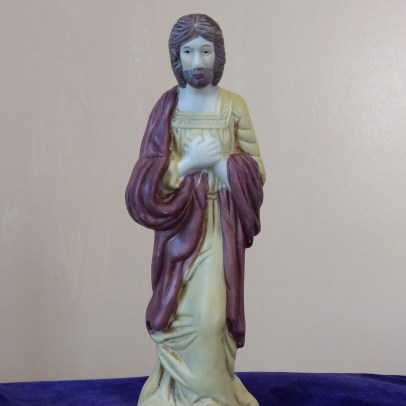
What do we learn from Matthew’s telling of the story?  Joseph is much like his Old Testament namesake; he is a dreamer of powerful dreams.  He is a righteous man, meaning that he wanted to do what was right in the sight of God, but he was also a compassionate man who, although he thought his future wife was unfaithful, wanted to make sure that she did not bear the shame of a broken engagement.  We also know that, when angels appear, Joseph pays attention.  He chooses not only to remain engaged to, but also marry, someone who everyone else might have rejected. Why?  Because he believes.  He believes that the child is the Son of God.  He believes that Mary is a God-bearer.  He believes that God will give him the strength to parent his only Son.  He believes that this child, named Jesus (God saves) will save the world.

This year, as we journey through the waiting dark of Advent into the light of Christmas, I pray that you will stop for a moment, take Joseph down from your nativity set, and see this story through his eyes.  Ask for his compassion, his faith, his love.  He is a truly a gift to the ongoing story of Christmas.

In Christ,

Pastor Breen

p.s.  Here’s a poem about Joseph that I have been working on.  It goes to the tune “O Come, O Come, Emmanuel.”

Old Joseph asked, “What do I do now?
It seems that Mary’s broken her vow.
The right thing is for her to flee.
I will dismiss her quietly.
Rejoice, rejoice, Emmanuel shall come to thee, O Israel.

“Behold, dear Joseph, have no fear;
Through Mary God is coming here.
Wed her and I will make you brave;
Name the child Jesus, for he will save.”
Rejoice, rejoice, Emmanuel shall come to thee, O Israel.

So Joseph took his wife and went.
To Bethlehem they had been sent.
She had the child before his eyes.
Wise men rejoiced; a star lit up the skies.
Rejoice, rejoice, Emmanuel shall come to thee, O Israel.

Another dream in dark of night:
“To Egypt you must take your flight.
King Herod comes to kill God’s Son.
It seems your journey has just begun.”
Rejoice, rejoice, Emmanuel shall come to thee, O Israel.

Food That Perishes

do-not-work-for-the-food-that-perishes-but-for-the-food-that-endures-for-eternal-life
photo by meatbell on flickr.com

John 6:25-35 (New Revised Standard Version)
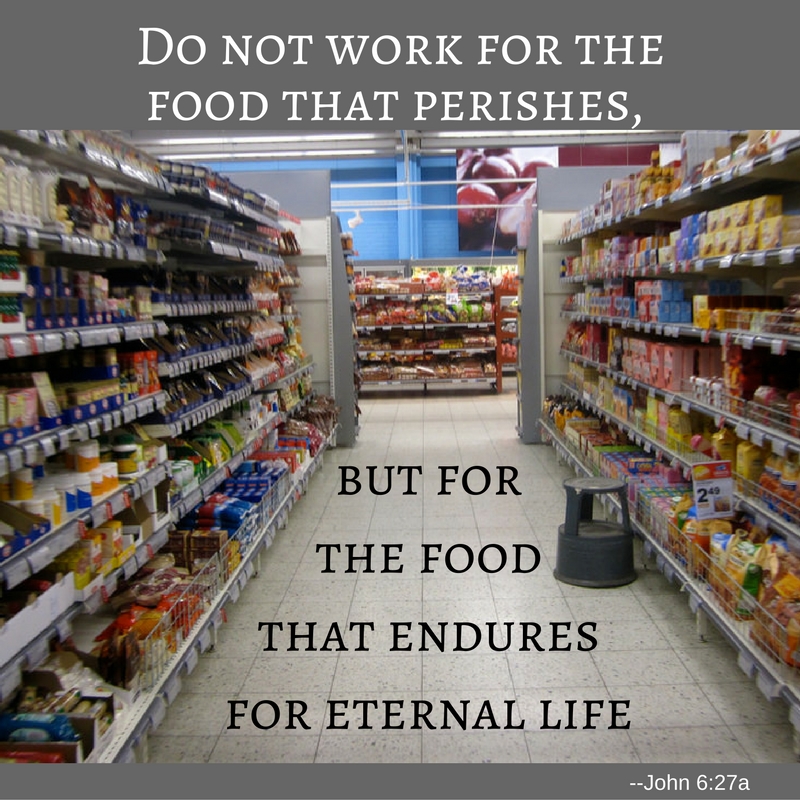
25When [the disciples] found [Jesus] on the other side of the sea, they said to him, “Rabbi, when did you come here?” 26Jesus answered them, “Very truly, I tell you, you are looking for me, not because you saw signs, but because you ate your fill of the loaves. 27Do not work for the food that perishes, but for the food that endures for eternal life, which the Son of Man will give you. For it is on him that God the Father has set his seal.” 28Then they said to him, “What must we do to perform the works of God?” 29Jesus answered them, “This is the work of God, that you believe in him whom he has sent.” 30So they said to him, “What sign are you going to give us then, so that we may see it and believe you? What work are you performing? 31Our ancestors ate the manna in the wilderness; as it is written, ‘He gave them bread from heaven to eat.’ ” 32Then Jesus said to them, “Very truly, I tell you, it was not Moses who gave you the bread from heaven, but it is my Father who gives you the true bread from heaven. 33For the bread of God is that which comes down from heaven and gives life to the world.” 34They said to him, “Sir, give us this bread always.”
35Jesus said to them, “I am the bread of life. Whoever comes to me will never be hungry, and whoever believes in me will never be thirsty.”

Devotional Questions from the ELCA Book of Faith Initiative:
What scares, confuses, or challenges me as I read this text?

What delights me as I read this text?

What stories or memories from my own life do I remember when I read this text? 

What do you think God is up to as you read this text?  What is God calling you to do or to be because of this story?

If you are like me, you have already started scouring the catalogs and ads that are arriving at your house for the perfect gift for each of the people on your Christmas gift list.  Maybe you are not, but no matter where you sit on the holiday celebrating spectrum, the holiday season has begun with Halloween, and the ads, pressures, and expectations (spoken or otherwise) won’t let up until after the new year.  It is an exhausting carousel to be on, especially when the advertisements, pressures, and expectations collide into a frenzy of what is just too much: too much for our wallets, too much of our time, and too much of our energy.  How will we ever get it right?

It is for all of these reasons that I am thankful that the reading from John will be our reading on Thanksgiving Eve and Day this year.  I find Jesus’ words in verse 27 especially poignant:  “Do not work for the food that perishes, but for the food that endures for eternal life, which the Son of Man will give you. For it is on him that God the Father has set his seal.”  What am I working for?  Who am I working for?  Is my work causing me to perish, or is it the very place where I find life?  And the best part of this verse?  Jesus gives us what we need, and we don’t have to worry about working for it.  We have a Savior who comes to us, who loves us, who saves us, not the other way around.

Emily Dickinson once wrote, “Because I could not stop for Death – He kindly stopped for me.”  I wonder if, during this hustle and bustle of the holiday season, if we forget to stop for life.  If we forget to stop, and breathe, and give thanks for all that we have been given, rather than worrying about all that we do not have.  All that we do not have that will not lead to life, anyway.

This month, as we plunge deeper into holiday preparations, I invite you to breathe.  Write down your priorities in pencil and, if they are not contributing to the life that really is life, erase and reorder them.  Take time to give thanks, and pause, and be still.  Receive the gifts that only God gives, and, if it is possible, ask for contentment with all you have been given.  It is God’s to give, after all, and God is both merciful and generous with all of his benefits.

I will keep you in my prayers, and look forward to studying with you during the month set aside for thankfulness.

In Christ,
Pastor Breen Marie Sipes