Like a Child

Fancy Nancy Party by skokiepl

Tri-Saints Lutheran Parish

Dwelling in the Word 

September 2018


Mark 9:30-37 (New Revised Standard Version)

30[Jesus and the disciples went on] and passed through Galilee. He did not want anyone to know it;31for he was teaching his disciples, saying to them, “The Son of Man is to be betrayed into human hands, and they will kill him, and three days after being killed, he will rise again.” 32But they did not understand what he was saying and were afraid to ask him.
33Then they came to Capernaum; and when he was in the house he asked them, “What were you arguing about on the way?” 34But they were silent, for on the way they had argued with one another who was the greatest. 35He sat down, called the twelve, and said to them, “Whoever wants to be first must be last of all and servant of all.” 36Then he took a little child and put it among them; and taking it in his arms, he said to them, 37“Whoever welcomes one such child in my name welcomes me, and whoever welcomes me welcomes not me but the one who sent me.”

ELCA Book of Faith Devotional Questions:

  1. What scares, confuses, or challenges me in this text? What do I have questions about?

I believe that this section of the story of Jesus is challenging because of the culture that we live in.  I have been in the market for workout clothes lately, and it seems to me that every piece that I see has some sort of message about being the best, or the hardest-working, or the one who wins.  We are taught win.  We are expected to win.  We believe that any cost is worth it, as long as we are first.  Does it surprise you to know that the disciples two thousand years ago worried about this, too?  It might be even more surprising to learn that this goal is not interesting to Jesus.  He says, “Whoever wants to be first must be last of all and servant of all.”  What does this mean in today’s world?  How can we, broken humans, ever hope to abandon our goal of “best” for the goal of “servant”?

  1. What delights me in this text? What is my favorite part, and why?

I love that Jesus uses the example of welcoming a child to show what the kingdom of God looks like.  Welcoming children is not always easy.  They come with many wants, and needs, and disruptions.  They need a lot of time and attention and love.  They are noisy, and wiggly, and full of hard questions.  What does it mean to us to welcome the children in our midst?  Several years back, I had a young lady who discovered how much “music” she could make standing on a wooden pew with her hard-soled shoes on.  She loved to dance, and did not hesitate to “make a joyful noise” during our time of worship.  It was driving her mother crazy!  She wanted to be in worship with her child, and knew what might happen if she tried to make her sit still for an entire service, but was so worried about the noise she was making that she could no longer worship God, and instead just endured her obligatory Sunday morning hour of torture.  When she brought this concern to me, we decided that the answer might actually be simple:  worship shoes.  Instead of hard-soled patent leather Mary Janes, we decided to try special ballet slippers that her daughter would only be allowed to wear in worship.  She could still dance and move without driving her mother crazy.  And it worked!  On the first Sunday that she had them, the little girl showed them off to me, saying, “Look at my special worship shoes!  Now I can show God how much I love him, and still hear you talk!”  We also got a mini-recital that day, and I was delighted.  How might we welcome that children that we have in our midst right now?  Do you think that Jesus only refers to children of a certain age, or are there other “children of God” who are more challenging to welcome, and yet important to make space for?  How can we work together to do this?

  1. What stories or memories does this text stir up in me? How does this story connect to the story of my life?

This summer, my husband and I visited a small, rural church to worship on a Sunday morning.  They were so surprised to see visitors that they weren’t sure what to do.  We were greeted, “You are?” to which we replied, “Here to worship.” “Oh!” they said, “Let’s turn the light on for you!”  Are we out of practice at welcoming the child, the widow, the orphan, the stranger?  What does it mean to be welcoming?  How can we minister even more fully to the children of God in our midst, whether week after week, or by pleasant surprise?

  1. What is God up to in this text? What is God calling me to do or to be because of this message?

I believe that God is calling us to give up our pursuit of greatness for the pursuit of him.  I believe that God is calling us to open our hearts and eyes to see those who need to be welcomed as children.  I believe that this church has a place for me, and that there is always more room at the table.

I am looking forward to Dwelling in this Word with you over the course of the month; may our conversation be fruitful, indeed!

In Christ, Pastor Breen Marie Sipes

Overwhelming Abundance

California quail by malfet
“California Quail” by malfet on flickr.com

Numbers 11:4-9, 18-20, 31-32 (New Revised Standard Version)

The rabble among them had a strong craving; and the Israelites also wept again, and said, “If only we had meat to eat! We remember the fish we used to eat in Egypt for nothing, the cucumbers, the melons, the leeks, the onions, and the garlic; but now our strength is dried up, and there is nothing at all but this manna to look at.”

Now the manna was like coriander seed, and its color was like the color of gum resin. The people went around and gathered it, ground it in mills or beat it in mortars, then boiled it in pots and made cakes of it; and the taste of it was like the taste of cakes baked with oil. When the dew fell on the camp in the night, the manna would fall with it.

18…Say to the people: Consecrate yourselves for tomorrow, and you shall eat meat; for you have wailed in the hearing of the Lord, saying, ‘If only we had meat to eat! Surely it was better for us in Egypt.’ Therefore the Lord will give you meat, and you shall eat. 19 You shall eat not only one day, or two days, or five days, or ten days, or twenty days, 20 but for a whole month—until it comes out of your nostrils and becomes loathsome to you—because you have rejected the Lord who is among you, and have wailed before him, saying, ‘Why did we ever leave Egypt?’”

31 Then a wind went out from the Lord, and it brought quails from the sea and let them fall beside the camp, about a day’s journey on this side and a day’s journey on the other side, all around the camp, about two cubits deep on the ground. 32 So the people worked all that day and night and all the next day, gathering the quails; the least anyone gathered was ten homers; and they spread them out for themselves all around the camp.

ELCA Book of Faith Devotional Questions:

  1. What scares, confuses, or challenges me in this text? What do I have questions about?

It challenges me that the people of God spent so much time complaining.  Aren’t they the ones who were chosen by God, created by God to be God’s holy people?  How can those whom God calls holy be such a mess?  I think sometimes we think that making a new commitment to Christ means that we will become more than human, super human, perfect.  Perfectly obedient.  Perfectly sinless.  Perfectly holy.  But that’s not reality, is it?  In Romans 3:23, Paul writes that “all have sinned and fall short of the glory of God.”  Belief is not a magic pill.  Turning over a new leaf doesn’t mean that our humanity will be stripped away.  It is normal, even expected, to have doubts, and fears, and times when we think we know better than God.  The good news?  God loves us messy people, and gives us even more that we can possibly ask or imagine.

  1. What delights me in this text? What is my favorite part, and why?

My favorite part of this text has always been when God says that he will give the people so much of the meat that they crave that it will come out of their nostrils.  The image reminds me of a time in Kindergarten when I laughed while eating tomato soup, and it came out my nose.  Grossed out yet?  It is gross (and it did hurt), but the idea that sometimes God answers our prayers with what WE think we need with even more that we can possibly take is reassuring to me.  Sometimes, I spend so much time worrying about what I do not have, about having more than enough, that I forget to look around me and be thankful for what I do have.  God was already providing manna and clean water for the people as a gift, six days per week.  How could they possibly want more?  And yet, they do.  And so, God provides.

  1. What stories or memories does this text stir up in me? How does this story connect to the story of my life?

This story reminds me of the summer that I spent in Norway.  Before I left, someone told me that if I were going overseas for any length of time, that I should bring a jar of peanut butter with me.  To be clear, I didn’t even like peanut butter at that time in my life, but I decided bringing it with me couldn’t hurt, so I did.  Everyday, I ate Norwegian food in homes of family friends and the school I attended.  And most days, I enjoyed the experience.  It was new, and novel, and fun to try to live in a way that we foreign to my own experience.  Then, the Fourth of July came and went, with no celebration, no fireworks, no s’mores.  And I started to long for the familiar food, faces, and language of home.  And I went back to my dorm room, and dug out that jar of unused peanut butter, got a pack of crackers, and ate and ate and ate.  And it tasted like home.  What tastes like home for you?  What do you long for?  What gift has God given you that reminds you of home?

  1. What is God up to in this text? What is God calling me to do or to be because of this message?

For the next month, we will be in the “Bread of Life” section of the Gospel of John.  By the end of the month, it just might feel like Jesus’ words about bread will be coming out our nostrils.  We may be rolling our eyes, and shaking our heads, and not-so-quietly commenting that we can’t wait until it’s over for another three years.  But what if we took a new tact?  What if we sank deeply into God’s abundance, and abided there awhile.  What if we slowed down, and listened, tasted and savored? What if we thanked God for all the abundance, rather than complaining about excess?  What if Jesus as the bread of life became the good news that we could not live without?  I look forward to Dwelling in this Word with you this month.

In Christ,
Pastor Breen Marie Sipes
Tri-Saints Lutheran Parish
Byron and Hardy, Nebraska

Come Away

“Come away to a deserted place all by yourselves and rest a while.”

Mark 6:30-34, 53-56 (New Revised Standard Version)

30The apostles gathered around Jesus, and told him all that they had done and taught. 31He said to them, “Come away to a deserted place all by yourselves and rest a while.” For many were coming and going, and they had no leisure even to eat. 32And they went away in the boat to a deserted place by themselves. 33Now many saw them going and recognized them, and they hurried there on foot from all the towns and arrived ahead of them. 34As he went ashore, he saw a great crowd; and he had compassion for them, because they were like sheep without a shepherd; and he began to teach them many things.
53When they had crossed over, they came to land at Gennesaret and moored the boat. 54When they got out of the boat, people at once recognized him, 55and rushed about that whole region and began to bring the sick on mats to wherever they heard he was. 56And wherever he went, into villages or cities or farms, they laid the sick in the marketplaces, and begged him that they might touch even the fringe of his cloak; and all who touched it were healed.

ELCA Book of Faith Devotional Questions:

  1. What scares, confuses, or challenges me in this text? What do I have questions about?

Have you ever had one of those days?  A day where you check something off of your “to do” list, and three more things seem to be added to it?  A day where you thought it was going to be nice and easy, and things took a turn, and you didn’t even have time to eat?  Did you know that the apostles had this experience as well?  It is challenging to me that even the ones closest to Jesus didn’t have things all together.  It reminds me that proximity to Jesus doesn’t guarantee smooth sailing, or an easy life, or easy answers to the suffering of the world.  Instead, it seems that once the eyes of the apostles were opened to the need for God’s power and presence in the world, they couldn’t shut them again.  Do I really want my eyes to be truly opened, if that’s what following Jesus means?

  1. What delights me in this text? What is my favorite part, and why?

I love that Jesus encourages them to “Come away to a deserted place all by yourselves and rest a while.”  As I write this, I am preparing for our annual week at Confirmation Camp, which is an opportunity for our 5-8 graders to get away to a deserted place, if only for a few days.  I am always amazed at the growth in faith that occurs during this intense experience, and it seems that it has the opportunity to be deep and wide because we are away from the familiar.  I am hoping to help our students to appreciate the power of rest, and stillness, and mindful concentration during this year’s camp, and will keep these words of Jesus close at hand.

  1. What stories or memories does this text stir up in me? How does this story connect to the story of my life?

Also as I write this, I am preparing to lead our group to the National Youth Gathering in Houston, Texas.  We are being sent, from the Tri-Saints, to experience a new city, and new people, and a new sense of what it means to be church, along with 37,000 of our closest Lutheran high school friends.  I am certain that, when we return from this life-altering experience, we will have many stories to tell and experiences to share.  We will be like the apostles, all crowding in on Jesus to shatter about our encounter with God’s mighty grace and power.  I hope that you will take the opportunity to take our youth aside to a deserted place and hear their stories of renewed, refreshed, and rejuvenated faith for yourselves.

  1. What is God up to in this text? What is God calling me to do or to be because of this message?

As I look forward to all of the experiences that are coming up this month, I pray that God will open my eyes to see how God is working in our world, country, and backyard.  I pray for rest and rejuvenation.  I pray for partners on this journey of serving the last, the least, the lost, and the lowly.  How might God be calling you?

In Christ, Pastor Breen Marie Sipes


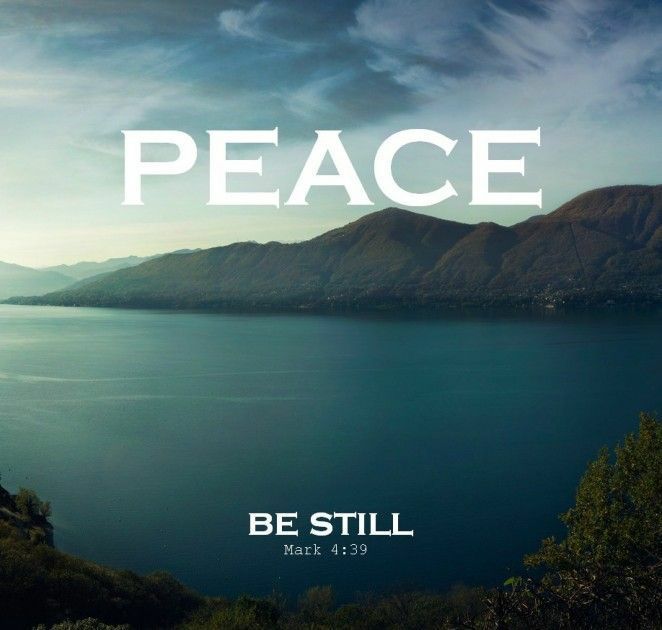
Peace! Be Still!

Peace be Still Shabby Shack on Pinterest

Mark 4:35-41 (New Revised Standard Version)

35When evening had come, [Jesus said to the disciples,] “Let us go across to the other side.” 36And leaving the crowd behind, they took him with them in the boat, just as he was. Other boats were with him. 37A great windstorm arose, and the waves beat into the boat, so that the boat was already being swamped. 38But he was in the stern, asleep on the cushion; and they woke him up and said to him, “Teacher, do you not care that we are perishing?” 39He woke up and rebuked the wind, and said to the sea, “Peace! Be still!” Then the wind ceased, and there was a dead calm. 40He said to them, “Why are you afraid? Have you still no faith?” 41And they were filled with great awe and said to one another, “Who then is this, that even the wind and the sea obey him?”

ELCA Book of Faith Devotional Questions:

What scares, confuses, or challenges me in this text? What do I have questions about?  One of my mentors, Pastor Carol Tomer, would always say the following on the occasion of a baptism:  “God does not promise us a life without rain or storms.  God promises that God will go with us through them.”  This is challenging, isn’t it? There are times in life when we also call out to God, “Teacher, do you not care that we are perishing?”  It is hard to confront the problem of evil in this world and not wonder where God might be in the midst of it all.  Is God there at all, especially when our boat is swamped, and the wind is fierce, and the waves threaten to overwelm?  Where is God when I don’t feel God’s presence?

What delights me in this text? What is my favorite part, and why?  My favorite part of this text is when Jesus wakes up and says “Peace!  Be still!”  When I am in frantic mode, unable to settle or trust or even call out to God, I try to keep these words of Jesus close to my heart.  For me, it might even be “Stop!  Be still!  Peace!”  It is when I take the time on my yoga mat to pray, or pull out a coloring prayer page I have been working on, light a candle, turn on my favorite hymn playlist, and make the time to just be.  That is where my peace is recovered, I recall that I am a beloved child of God, and I remember that God through the Holy Spirit is as close to me as my next breath.  Ahh…the blessed rest of peace.

What stories or memories does this text stir up in me? How does this story connect to the story of my life?  This story has always been a memorable one since I led a group of confirmation students on a sailboat on the south shore of Lake Superior.  As we were sailing one day, a storm began brewing.  The captain of the sailboat, who had many years of experience sailing just these waters, said to me, “We have two choices.  Try to get to land and off the boat before the storm comes in, or ride it out on the water.”  I asked him which option was safer.  He told me that, if the students and I were willing to do exactly what he said to sail the boat, it was actually safer to ride it out.  Making for shore meant that there was a possibility that we might wreck, and the boat was made for storms such as these.  We decided to ride it out.  What an exciting, exhilarating, terrifying ride!  We made it safely through the storm, and the sunset over a lake as smooth as glass that evening was one of the most beautiful I had seen.  Then came the crazy part.  When I pulled out our pre-prepared devotion that night, it was this very story!  You can imagine that the students, captain, and I had quite the deep discussion for Bible study that night.

What is God up to in this text? What is God calling me to do or to be because of this message?  I have been listening to a recording of “My Hope is Built on Nothing Less” by the Norton Hall Band at Southern Seminary lately.  When I read this story from Mark, it reminds me of a couple of lines from the hymn:  “In every high and stormy gale, my anchor holds within the veil.”  In the storms of life, where is my anchor fixed?  Who walks with me through the dark times?  How do I seek God’s face, even the valley of the shadow of death?  Jesus promises to go with us, to be present, to give us peace and strength and hope.  “All other ground is sinking sand.”  I am looking forward to Dwelling in this Word with you over the course of the month.

In Christ,

Pastor Breen Marie Sipes

On the Way

IMG_20180423_135707466


Acts 1:1-11 (NRSV)

[Luke writes:] 1In the first book, Theophilus, I wrote about all that Jesus did and taught from the beginning 2until the day when he was taken up to heaven, after giving instructions through the Holy Spirit to the apostles whom he had chosen. 3After his suffering he presented himself alive to them by many convincing proofs, appearing to them during forty days and speaking about the kingdom of God. 4While staying with them, he ordered them not to leave Jerusalem, but to wait there for the promise of the Father. “This,” he said, “is what you have heard from me; 5for John baptized with water, but you will be baptized with the Holy Spirit not many days from now.”
6So when they had come together, they asked him, “Lord, is this the time when you will restore the kingdom to Israel?” 7He replied, “It is not for you to know the times or periods that the Father has set by his own authority. 8But you will receive power when the Holy Spirit has come upon you; and you will be my witnesses in Jerusalem, in all Judea and Samaria, and to the ends of the earth.” 9When he had said this, as they were watching, he was lifted up, and a cloud took him out of their sight. 10While he was going and they were gazing up toward heaven, suddenly two men in white robes stood by them. 11They said, “Men of Galilee, why do you stand looking up toward heaven? This Jesus, who has been taken up from you into heaven, will come in the same way as you saw him go into heaven.”

ELCA Book of Faith Devotional Questions:

  1. What scares, confuses, or challenges me in this text? What do I have questions about?

The challenging part for me in this text is that I like my life to run on a schedule.  I am always making plans, and once something has made it onto my calendar, it might as well be set in stone.  Here, Jesus says “It is not for you to know the times or periods that the Father has set by his own authority” (Acts 1:7).  The disciples want to know when the next stage of God’s salvation plan will begin, and Jesus tells them that knowing is not a part of the plan.  I know that God works on a time table that is vastly different than ours is, but knowing this and being comfortable with it are two different things.  When was a time in your life when you wanted God to work on your time table?  How did it work out?

  1. What delights me in this text? What is my favorite part, and why?

The true delight to me in this text is that Jesus does not leave us alone.  The Ascension is another part of God’s rescue plan, and that plan includes the indwelling of the Holy Spirit among us.  It is the Holy Spirit that gives the disciples to power to launch the Christian church all the way out to the edges of the known world.  In my own life, it is the wisdom and courage of the Holy Spirit that helps me to step out in faith, even when I am not sure of the next step.  When was a time in your life when you knew or felt the presence of Jesus or the Holy Spirit in your life?  What difference did it make?

  1. What stories or memories does this text stir up in me? How does this story connect to the story of my life?

When I was serving in central Pennsylvania, Ascension Day was a major holiday in our community.  The local Amish took the day off to go fishing, and it was a time to gather together as a community to celebrate.  One year, another local pastor and my self had commissioned the Boy Scout Troup to build rockets to launch as a part of the celebration.  We all gathered on the church lawn to launch the rockets.  As soon as all of us were looking skyward, trying to catch the last glimpse of the rockets at their zenith, the other pastor quoted the white-robed men in Acts, “[Men and women of Kratzerville], why do you stand looking up toward heaven? This Jesus, who has been taken up from you into heaven, will come in the same way as you saw him go into heaven.”  I will always remember his perfect timing with that quote, because it reminds me not to hold on to the things that are past and gone, even if they were wonderful, but to keep my feet firmly planted on the earth and be open to where the Spirit is leading, here and now and in this place.  What parts of the past are you holding onto?  How is the past keeping you from seeing where God is working in the present?  How are you being called to see your life, your church, your community with new eyes?

  1. What is God up to in this text? What is God calling me to do or to be because of this message?

God is calling Jesus back to his rightful place at the Father’s right hand in glory.  God is preparing to send the Holy Spirit, and to release the disciples as witnesses to the power of Jesus’ resurrection, all the way to the ends of the earth.  He is calling me to live into this good news as another joyful witness who is always looking for the presence of God working, in and among us.  In what ways is God calling you to be a witness, in your life, in our community, across the world?

I look forward to celebrating the Ascension with you, Easter people!

In Christ,

Pastor Breen Marie Sipes

Watch and Pray: Maundy Thursday to Easter

11b65f8104d3e5a1637d86726f844382

I developed this resource for the Tri-Saints this Holy Week to help us all to watch and pray throughout the Three Days.

You can find a pdf of this resource here:  Watch and Pray:  Good Friday Seven Last Words

You can find the children and family version of this resource here:  Watch and Pray:  Good Friday for Families

Tenebrae:  The Seven Last Words of Jesus

     The word “tenebrae” comes from the Latin meaning “darkness.” The Tenebrae is an ancient Christian Good Friday service that makes use of gradually diminishing light through the extinguishing of candles along with the Seven Last Words, or phrases, that Jesus said from the time he was crucified until he died.

     The increasing darkness symbolizes the approaching darkness of Jesus’ death and of hopelessness in the world without God. The service concludes in darkness, sometimes with a final candle, the Christ candle, carried out of the sanctuary, symbolizing the death of Jesus. A loud noise may also sound symbolizing the closing of Jesus’ tomb. The worshipers then leave in silence to ponder the impact of Christ’s death and await the coming Resurrection.(http://www.umc.org/what-we-believe/what-is-a-tenebrae-service)

     We invite you to watch and pray throughout the next Three Days (Maundy Thursday, Good Friday, and Holy Saturday) by reading these Words over and over again and considering their meaning for you in your life.  A blessed continuation of the Three Days to you.

First Word:  Luke 23:32-38                              

Two others also, who were criminals, were led away to be put to death with him.  When they came to the place that is called The Skull, they crucified Jesus there with the criminals, one on his right and one on his left.  [Then Jesus said, “Father, forgive them; for they do not know what they are doing.”] And they cast lots to divide his clothing.  And the people stood by, watching; but the leaders scoffed at him, saying, “He saved others; let him save himself if he is the Messiah of God, his chosen one!”  The soldiers also mocked him, coming up and offering him sour wine, and saying, “If you are the King of the Jews, save yourself!”  There was also an inscription over him, “This is the King of the Jews.”

Second Word:  Matthew 27:45-49                   

From noon on, darkness came over the whole land until three in the afternoon.  And about three o’clock Jesus cried with a loud voice, “Eli, Eli, lema sabachthani?” that is, “My God, my God, why have you forsaken me?”  When some of the bystanders heard it, they said, “This man is calling for Elijah.”  At once one of them ran and got a sponge, filled it with sour wine, put it on a stick, and gave it to him to drink.  But the others said, “Wait, let us see whether Elijah will come to save him.”

Third Word:  Luke 23:39-43                            

One of the criminals who were hanged there kept deriding him and saying, “Are you not the Messiah? Save yourself and us!”  But the other rebuked him, saying, “Do you not fear God, since you are under the same sentence of condemnation?  And we indeed have been condemned justly, for we are getting what we deserve for our deeds, but this man has done nothing wrong.”  Then he said, “Jesus, remember me when you come into your kingdom.”  He replied, “Truly I tell you, today you will be with me in Paradise.”

Fourth Word:  John 19:25b-27                        

Meanwhile, standing near the cross of Jesus were his mother, and his mother’s sister, Mary the wife of Clopas, and Mary Magdalene.  When Jesus saw his mother and the disciple whom he loved standing beside her, he said to his mother, “Woman, here is your son.”  Then he said to the disciple, “Here is your mother.” And from that hour the disciple took her into his own home.

Fifth Word:  John 19:28-29                              

After this, when Jesus knew that all was now finished, he said (in order to fulfill the scripture), “I am thirsty.”  A jar full of sour wine was standing there. So they put a sponge full of the wine on a branch of hyssop and held it to his mouth.

Sixth Word:  Luke 23:44-46a                           

It was now about noon, and darkness came over the whole land until three in the afternoon, while the sun’s light failed; and the curtain of the temple was torn in two.  Then Jesus, crying with a loud voice, said, “Father, into your hands I commend my spirit.”

Last Word:  John 19:30                                    

When Jesus had received the wine, he said, “It is finished.” Then he bowed his head and gave up his spirit.

New Revised Standard Version Bible, copyright © 1989 the Division of Christian Education of the National Council of the Churches of Christ in the United States of America. Used by permission. All rights reserved. http://www.biblegateway.com

Heart Promise: Dwelling in the Word March 2018

2d6d5967df1ff37995b9e5c09132055d

This year during Lent, our readings from the Old Testament will focus on the five covenants, or promises, that God made with the people of Israel before the coming of Jesus.  Each covenant makes a shift in the people from past to new future that reminds us of our baptism.  This is the fifth covenant, which God makes as a future promise to Israel.

Jeremiah 31:31-34 (New Revised Standard Version)
31The days are surely coming, says the Lord, when I will make a new covenant with the house of Israel and the house of Judah. 32It will not be like the covenant that I made with their ancestors when I took them by the hand to bring them out of the land of Egypt—a covenant that they broke, though I was their husband, says the Lord. 33But this is the covenant that I will make with the house of Israel after those days, says the Lord: I will put my law within them, and I will write it on their hearts; and I will be their God, and they shall be my people. 34No longer shall they teach one another, or say to each other, “Know the Lord,” for they shall all know me, from the least of them to the greatest, says the Lord; for I will forgive their iniquity, and remember their sin no more.

Devotional Questions from the ELCA’s Book of Faith Initiative:
What scares, confuses, or challenges me in this text?  What do I have questions about?

What delights me in this text?  What do I like about it?

What stories or memories does this text stir up in me?  You might remember a time when you learned something by heart, or suddenly remembered something that you had learned by heart in time’s past, for example. 

What is God up to in this text?  What is God calling you to do or to be because of this story?

Rainbow Promise: Dwelling the the Word February 2018

This year during Lent, our readings from the Old Testament will focus on the five covenants, or promises, that God made with the people of Israel before the coming of Jesus.  Each covenant makes a shift in the people from past to new future that reminds us of our baptism.  This is the first covenant, which God makes with Noah after the flood.

 rainbow near finland by lyza by nc sa 2.0

Genesis 9:8-17 (New Revised Standard Version)

8God said to Noah and to his sons with him, 9“As for me, I am establishing my covenant with you and your descendants after you, 10and with every living creature that is with you, the birds, the domestic animals, and every animal of the earth with you, as many as came out of the ark. 11I establish my covenant with you, that never again shall all flesh be cut off by the waters of a flood, and never again shall there be a flood to destroy the earth.” 12God said, “This is the sign of the covenant that I make between me and you and every living creature that is with you, for all future generations: 13I have set my bow in the clouds, and it shall be a sign of the covenant between me and the earth. 14When I bring clouds over the earth and the bow is seen in the clouds, 15I will remember my covenant that is between me and you and every living creature of all flesh; and the waters shall never again become a flood to destroy all flesh. 16When the bow is in the clouds, I will see it and remember the everlasting covenant between God and every living creature of all flesh that is on the earth.” 17God said to Noah, “This is the sign of the covenant that I have established between me and all flesh that is on the earth.”

Devotional Questions from the ELCA’s Book of Faith Initiative:

What scares, confuses, or challenges me in this text?  What do I have questions about?

I do not like flooding.  When my family and I lived in central Pennsylvania, flooding was an almost yearly reality.  The thing about flooding that I especially did not like was the anticipation.  When there is a tornado or snowstorm, it happens, and it is over, and then the clean up begins.  With flooding, you know that it is raining, and that it is going to flood, but you have all sorts of time to think about it, to watch it rise, to endure it, and then to watch it slowly sink back away.  It is an extremely helpless feeling, and a reminder that, ultimately you have no control.  I am challenged by the story of the flood because I know the dread that I feel in relation to flooding, and I can’t imagine having to endure a world-wide flood, especially in response to the sin of others.  I wonder how Noah’s family endured such a difficult thing.  Did it draw them closer to God?  To one another?  Did they learn that they had strength beyond what they had imagined before?

What delights me in this text?  What do I like about it?

When we lived in central Pennsylvania, most of the flooding that occurred was because of hurricanes on the coast.  As nasty as the rain, wind and flooding were, my favorite days of weather were always the day after a hurricane.  The morning would dawn sunny and clear, the air would smell clean and fresh and new, and it seemed like anything was possible.  I wonder if that’s how Noah and his family felt when they were finally released from the ark.  Were they relieved?  Did the world seem fresh and new?  Were they ready for a new start?

What stories or memories does this text stir up in me?  You might remember a time when someone made a promise to you, or you made a promise to someone else, for example.

This story reminds me to take the time to look around.  To see the rainbow, or the sunrise, or the beautiful configuration of the stars.  I am reminded to listen for the cry of the hawk, or the rushing of wind through the trees, or even the sound of sheer silence, when it feels like even nature is holding its breath and listening for God to speak.  God spoke to Noah through the rainbow, and I wonder what it was like to remember God’s voice, God’s promise, living through the flood, each time a rainbow appeared after a storm.  What was it like to be God’s people of the rainbow promise?

What is God up to in this text?  What is God calling you to do or to be because of this story?

I am looking forward to walking with you through these promises of God during Lent this year.  Together, we will remember the rainbow (Noah), the stars in the sky (Abraham), the Ten Commandments (Moses), the bronze serpent (Moses), and the law on our hearts (Jeremiah).  Together, we will listen for God’s voice calling us to baptismal remembrance.  Together, we will discover God’s call for us, here and now and in this place.  As always, I am looking forward to discovering what this old, old story has to say to us.

In Christ’s promise,  Pastor Breen Marie