Jesus said to the disciples, “There was a rich man who had a manager, and charges were brought to him that this man was squandering his property. So he summoned him and said to him, `What is this that I hear about you? Give me an accounting of your management, because you cannot be my manager any longer.’ Then the manager said to himself, `What will I do, now that my master is taking the position away from me? I am not strong enough to dig, and I am ashamed to beg. I have decided what to do so that, when I am dismissed as manager, people may welcome me into their homes.’ So, summoning his master’s debtors one by one, he asked the first, `How much do you owe my master?’ He answered, `A hundred jugs of olive oil.’ He said to him, `Take your bill, sit down quickly, and make it fifty.’ Then he asked another, `And how much do you owe?’ He replied, `A hundred containers of wheat.’ He said to him, `Take your bill and make it eighty.’ And his master commended the dishonest manager because he had acted shrewdly; for the children of this age are more shrewd in dealing with their own generation than are the children of light. And I tell you, make friends for yourselves by means of dishonest wealth so that when it is gone, they may welcome you into the eternal homes.
“Whoever is faithful in a very little is faithful also in much; and whoever is dishonest in a very little is dishonest also in much. If then you have not been faithful with the dishonest wealth, who will entrust to you the true riches? And if you have not been faithful with what belongs to another, who will give you what is your own? No slave can serve two masters; for a slave will either hate the one and love the other, or be devoted to the one and despise the other. You cannot serve God and wealth.”
ELCA Book of Faith Devotional Questions:
What scares, confuses, or challenges me in these texts? What do I have questions about?
What delights me in these texts? What is my favorite part, and why?
What stories or memories do these texts stir up in me? How do these stories connect to the story of my life?
What is God up to in these texts? What is God calling me to do or to be because of this message?
This summer, the Holy Spirit has been at work providing nudges toward our service projects and Mission Festival. Cheri Biltoft approached me in June with an idea for a Mission Festival Speaker. Her granddaughter, Jayme Smock, had just taken a job with the Child Advocacy Center of Lincoln as a forensic interviewer. Her work includes doing intake interviews for children in our area of the state who have been abused or have been victims of human trafficking and testifying in court about those interviews. Cheri thought she would make a good Mission Festival Speaker, and, after talking with Jayme, I agreed. We will not only get to host her for the Mission Festival, we will also partner with the Child Advocacy Center on God’s Work our Hands Sunday to make fleece tied blankets for those children who need to undergo an medical exam at the center.
A couple of weeks later, Crystal Krenke shared with me that she and her scrapbooking group had been to Royal Kids Family Camp, which is a camp at Covenant Cedars camp in Hordeville. The camp is for abused and trafficked children, and the scrapbooking group goes to make scrapbooks for each child with pictures from their time at camp. She wondered if there was a way that the Tri-Saints could partner with her group in the future, and we decided to help them on God’s Work our Hands Sunday by putting together background pages for the scrapbooks.
Through these two contacts, our God’s Work our Hands Sunday and Mission Festival topic began to take shape, and I began to realize that we had other connections to make. When I was at the WELCA Triennial Gathering in 2017, I met a deaconess who was involved with the SOAP Project, and organization who provides bar soap to hotels with a label on the back with the hotline number, texting info, and snapchat for the National Human Trafficking Hotline. They are a national organization based in Ohio, and on God’s Work Our Hands Sunday, we will put the labels on the soaps for the organization to distribute.
Also this summer, our Carol Joy Holling campers participated in a service project of making fleece tied blankets for those who are suffering from depression and anxiety. I contacted the camp to see if we could continue to help with this cause, and was directed to the Linus Project of Omaha. This is the organization to which we give the NICU quilts to be distributed to the NICU at the Med Center, but they also provide simple fleece blankets for all sorts of organizations who support child in medical need, physical need, or crisis. We will partner with them on these type of blankets, as well.
One organization that we partner with in an ongoing basis is Lutheran World Relief. We send kits and quilts several times per year through our women’s organizations and confirmation class. They have recently begun receiving fleece tied blankets as well, and so some of the blankets we make on God’s Work our Hands Sunday will go there. It is with joy and thanksgiving that we are able to help more generations to learn about this important and enduring work.
How can I help?
Join us at the Hardy Community Hall, one block west of the church, at 9:15 AM on Sunday, September 15 with willing hands. No experience or extra supplies are necessary, and there are projects for every age and ability. If you like, you can also bring some supplies along:
S.O.A.P. Project: Label soaps to be put into hotels to get hotline number into the hands of those who may be trafficked. No supplies needed; everything will be provided.
Child Advocacy Center of Lincoln: Tied Fleece blankets for abused and trafficked children in our area of the state. You can bring sharp fabric scissors, 1.5 yards each of a printed fleece fabric and a coordinating solid. Walmart has a great selection of fleece already cut into 1.5 yard sections. Thanks to a grant from Tri-Saints and Thrivent, some fleece will be provided.
Royal Kids Family Camp in Hordeville, NE: Scrapbook pages for children who have been abused or trafficked to remember their week at camp. You can bring paper scissors and glue sticks. All other resources will be provided.
Linus Project: Simple Fleece Blankets for Omaha area children and youth in need. You can bring sharp fabric scissors, seam rippers, 1.5 yards of printed fabric per blanket (no solid needed). Walmart has a great selection of fleece already cut into 1.5 yard sections. Thanks to a grant from Tri-Saints and Thrivent, some fleece will be provided.
Lutheran World Relief: Tied Fleece Blankets which go to all ages of people around the world and across the street. You can bring sharp fabric scissors, 1.5 yards each of a printed fleece fabric and a coordinating solid. Walmart has a great selection of fleece already cut into 1.5 yard sections. Thanks to a grant from Tri-Saints and Thrivent, some fleece will be provided.
We are looking forward to a great, Spirit-filled day of learning and service. May God bless both our hands and feet as we work together to serve the Lord!
Who has seen the wind?
Neither I nor you.
But when the leaves hang trembling,
The wind is passing through.
Who has seen the wind?
Neither you nor I.
But when the trees bow down their heads,
The wind is passing by. (Christina Rosetti)
On Pentecost Sunday, I reflected back to you that you don’t think that we, as the Tri-Saints, or Lutherans for that matter, talk about the Holy Spirit enough. In my sermon that day, I gave you several instances of the Holy Spirit showing up in scripture, often in very different and surprising ways. I offered all of these instances as an out-pouring of the Holy Spirit that could carry us through the summer. As you read the passages which follow, which images of the Holy Spirit grab hold of you? Carry them with you in your devotional time this summer. Invite the Holy Spirit to work on you, both through these texts, and through the places and ways in which the Holy Spirit calls you to be a Child of God in the world. It just might change your life…
Likewise the Spirit helps us in our weakness; for we do not know how to pray as we ought, but that very Spirit intercedes with sighs too deep for words. (Romans 8:26 NRSV)
God said to Elijah, “Go out and stand on the mountain before the Lord, for the Lord is about to pass by.” Now there was a great wind, so strong that it was splitting mountains and breaking rocks in pieces before the Lord, but the Lord was not in the wind; and after the wind an earthquake, but the Lord was not in the earthquake; 12 and after the earthquake a fire, but the Lord was not in the fire; and after the fire a sound of sheer silence. (2 Kings 19:11-12 NRSV)
All who are led by the Spirit of God are children of God. For you did not receive a spirit of slavery to fall back into fear, but you have received a spirit of adoption. When we cry, “Abba! Father!” it is that very Spirit bearing witness with our spirit that we are children of God (Romans 8:14-16 NRSV)
In the beginning when God created the heavens and the earth, 2 the earth was a formless void and darkness covered the face of the deep, while a wind from God swept over the face of the waters. (Genesis 1:1-2 NRSV)
If you love me, you will keep my commandments. 16 And I will ask the Father, and he will give you another Advocate, to be with you forever. 17 This is the Spirit of truth, whom the world cannot receive, because it neither sees him nor knows him. You know him, because he abides with you, and he will be in you. (John 14:15-17 NRSV)
When the day of Pentecost had come, the disciples were all together in one place. And suddenly from heaven there came a sound like the rush of a violent wind, and it filled the entire house where they were sitting. Divided tongues, as of fire, appeared among them, and a tongue rested on each of them. All of them were filled with the Holy Spirit and began to speak in other languages, as the Spirit gave them ability. (Acts 2:1-4 NRSV)
Jesus said to them again, “Peace be with you. As the Father has sent me, so I send you.” 22 When he had said this, he breathed on them and said to them, “Receive the Holy Spirit. 23 If you forgive the sins of any, they are forgiven them; if you retain the sins of any, they are retained.” (John 20:21-23 NRSV)
But the Advocate, the Holy Spirit, whom the Father will send in my name, will teach you everything, and remind you of all that I have said to you. (John 14:26)
Who has seen the Spirit?
Neither I nor you.
But when our prayers are heard by God,
The Spirit’s passing through.
Who has seen the Spirit?
Neither you nor I.
But when our hearts are set on fire,
The Spirit’s passing by. (Breen Sipes)
Are you ready for a new season? I know that I am! Spring may still be a few weeks away, but a new season in the church, Lent, begins on March 6th with Ash Wednesday. The Tri-Saints Worship and Music Committee, confirmation students, and I have been hard at work getting fresh, new resources ready for you, and wanted to give you a place to find all of our great resources for all ages and stages. Check it out!
Handheld Prayers
What does a jingle bell, click pen, stone, binder clip, paperclip, warm fuzzy, and quarter have to do with quiet prayer? On Sundays in Lent, Quiet Lent Prayer Practices will return with all new Handheld Prayers. Our Handheld prayer satchels will contain five small objects that fit in our hands and remind us in a small, everyday way of the many options we have when we open the conversation to God in prayer.
One of the promises of God in the prophet Jeremiah is this: “I will put my law within them, and I will write it on their hearts; and I will be their God, and they shall be my people” (Jeremiah 31:33). During this time of growth in discipleship, we will take one of the verses of Paul’s letter to the Romans as a conversation partner and work to write it, both on our minds and our hearts. Here are the verses we will focus on:
Romans 3:23 “All have sinned and fallen short of the glory of God.”
Romans 6:22 “Now that you have been freed from sin and enslaved to God…the end is eternal life.”
Romans 8:25 “If we hope for what we do not see, we wait for it with patience.”
Romans 10:15 “How beautiful are the feet of those who bring good news!”
Romans 12:5 “We, who are many, are one body in Christ, and individually we are members one of another.”
Romans 15:13 “May the God of hope fill you with all joy and peace in believing, so that you may abound in hope by the power of the Holy Spirit.”
Sunday Season of Hope: LWR Personal Care Kits
We continue our habit of the past several years of gathering items for Personal Care Kits for Lutheran World Relief. Please bring these items to your church in Lent; the Sunday School children and Confirmation youth will assemble them on Easter morning. Items needed include soap, bath towels, wide-tooth combs, and nail clippers (we have plenty of toothbrushes from previous years). Please consider giving out of your abundance to those who would consider these items a true miracle from God.
What do name tags, colored pencils, Mission Possible Cards, Tickets to Heaven, play dough, dissolving paper, crocheted labyrinths, and glow bracelets have to do with prayer? Our confirmation students have been studying the Lord’s Prayer since Christmas, and are excited to share several prayer experiences exploring the petitions of the Lord’s Prayer with you over the course of our Lenten Midweek services. They will also be sharing their gifts of music throughout our midweek gatherings.
The Parish Council has decided to designate our Midweek offering to our three county food shelves. Although we usually think of hunger during Thanksgiving and Christmas, the need persists all year. Please be generous in obeying Jesus’ command to feed our hungry neighbors, right here in our community.
Dive Deeper Lenten Study: Romans
The subject of our gatherings during Lenten midweek this year is Paul’s Letter to the Romans. This letter is a treasure trove of some of the deepest truths of our Christian faith, and also can be one of the most confusing. As we prepare to dive deeply into this beloved book, I offer the following passage for us to Dwell in this month: https://pbsipes.wordpress.com/2019/03/05/saved-in-hope-dwelling-in-the-word-march-2019/
If you prefer a weekly study, this is our Lenten Devotion Book from ReFrame Media:
This year during Lenten Midweek services, we will be diving deeper into Paul’s Letter to the Romans from the Bible. I found a bunch of great resources to study this letter from ReFrame Media, and you can find each weekly devotion here:
If you would like to download the whole thing as a booklet with included coloring meditations, pick up a copy at church or find it here: Devotion Book Reframe Media
I consider that the sufferings of this present time are not worth comparing with the glory about to be revealed to us. 19 For the creation waits with eager longing for the revealing of the children of God; 20 for the creation was subjected to futility, not of its own will but by the will of the one who subjected it, in hope 21 that the creation itself will be set free from its bondage to decay and will obtain the freedom of the glory of the children of God. 22 We know that the whole creation has been groaning in labor pains until now; 23 and not only the creation, but we ourselves, who have the first fruits of the Spirit, groan inwardly while we wait for adoption, the redemption of our bodies. 24 For in hope we were saved. Now hope that is seen is not hope. For who hopes for what is seen? 25 But if we hope for what we do not see, we wait for it with patience.
26 Likewise the Spirit helps us in our weakness; for we do not know how to pray as we ought, but that very Spirit intercedes with sighs too deep for words. 27 And God, who searches the heart, knows what is the mind of the Spirit, because the Spirit intercedes for the saints according to the will of God.
28 We know that all things work together for good for those who love God, who are called according to his purpose. 29 For those whom he foreknew he also predestined to be conformed to the image of his Son, in order that he might be the firstborn within a large family. 30 And those whom he predestined he also called; and those whom he called he also justified; and those whom he justified he also glorified.
ELCA Book of Faith Devotional Questions:
What scares, confuses, or challenges me in this text? What do I have questions about?
Whenever I am studying the letters of Paul, I find it helpful to break it down into small chunks, sometimes even into just words or phrases. What words or phrases tug at your ear, your eyes, your heartstrings? One sentence in this passage that I have always had a hard time with is in verse 28: “We know that all things work together for good for those who love God.” It is especially hard to believe in this statement when someone we know and love is going through a rough patch. Where is the good here? Why can’t I see it? It reminds me of Joseph from the book of Genesis, and his great capacity for forgiveness to his brothers. Where do I find good, in the midst of sorrow? Where is the light of Christ, when all seems dark?
What delights me in this text? What is my favorite part, and why?
My favorite phrase in this passage was first introduced to me as a song: “The Spirit intercedes for us with sighs too deep for words to express” (vs. 26) This expression of the Spirit as a sigh connects to my practice of yoga as a prayer practice. The entire practice, including the super-bendy, more challenging movements, are animated only by breath. We breathe in, and ask the Spirit to fill us. We breathe out, and ask the Spirit to move us. Sometimes, our ability to put experiences into words fails us, and it is helpful to me to know that the Spirit moves with me, speaks for me, when the end of my words has come.
What stories or memories does this text stir up in me? How does this story connect to the story of my life?
Lent is a perfect season for the practice of hope, as we see in verse 25: “If we hope for what we do not see, we wait for it with patience.” It is hard to be patient for spring, for warmer temperatures and melting snow, for new life and the flurry of activity that that entails. My patience has certainly been tried on multiple occasions this past winter, and I am reminded in this verse that patience and hope go hand in hand.
What is God up to in this text? What is God calling me to do or to be because of this message?
This passage is one of the most important things that Paul ever wrote. How is it speaking to you, during this season of deepening faith and discipleship? I pray that it may come to be your friend, if even in tiny doses, as we dwell in this Word together over the next month.
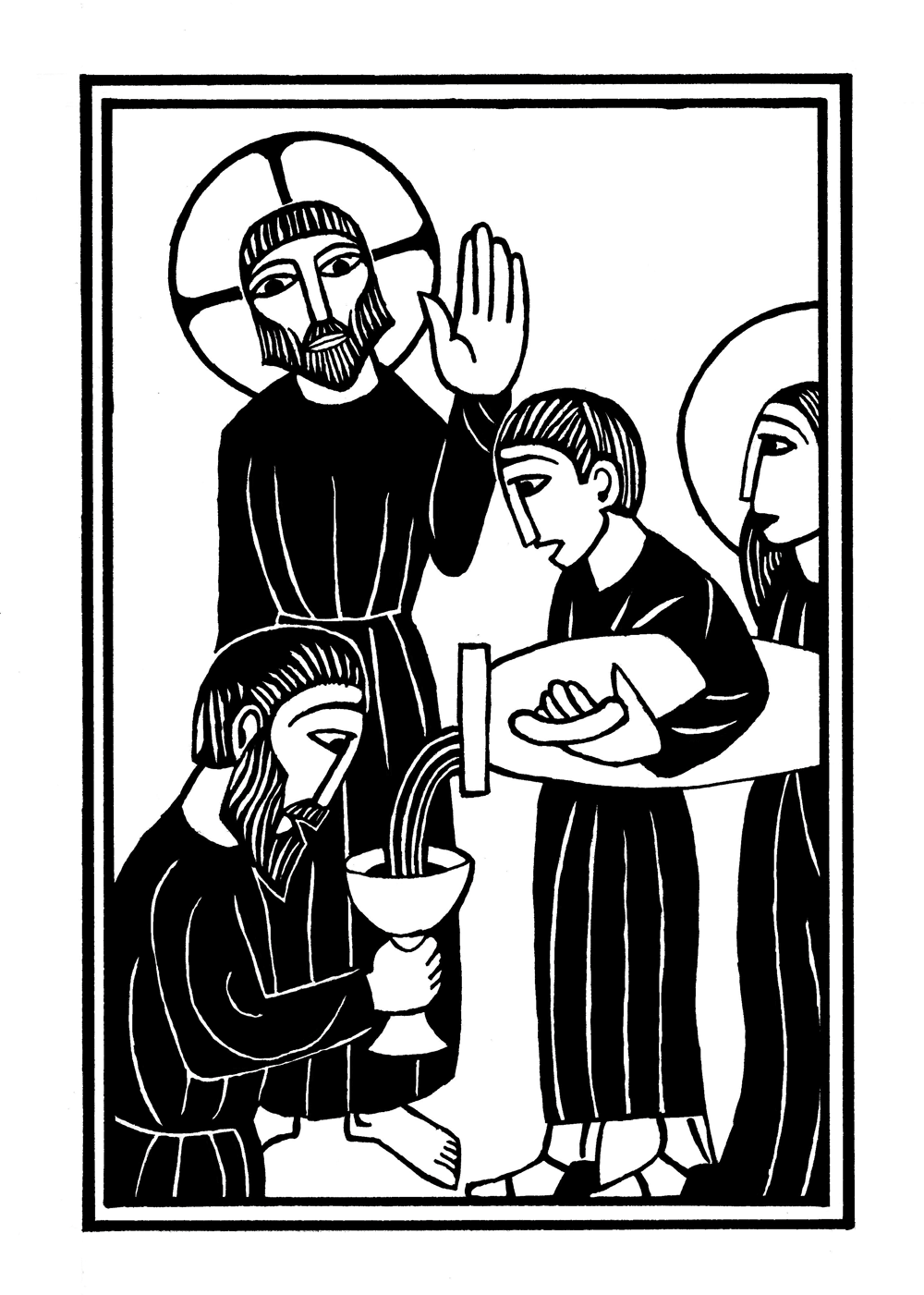
1On the third day there was a wedding in Cana of Galilee, and the mother of Jesus was there. 2Jesus and his disciples had also been invited to the wedding. 3When the wine gave out, the mother of Jesus said to him, “They have no wine.” 4And Jesus said to her, “Woman, what concern is that to you and to me? My hour has not yet come.” 5His mother said to the servants, “Do whatever he tells you.” 6Now standing there were six stone water jars for the Jewish rites of purification, each holding twenty or thirty gallons. 7Jesus said to them, “Fill the jars with water.” And they filled them up to the brim. 8He said to them, “Now draw some out, and take it to the chief steward.” So they took it. 9When the steward tasted the water that had become wine, and did not know where it came from (though the servants who had drawn the water knew), the steward called the bridegroom 10and said to him, “Everyone serves the good wine first, and then the inferior wine after the guests have become drunk. But you have kept the good wine until now.” 11Jesus did this, the first of his signs, in Cana of Galilee, and revealed his glory; and his disciples believed in him.
ELCA Book of Faith Devotional Questions:
What scares, confuses, or challenges me in this text? What do I have questions about? I have always been a little disturbed by the way that Jesus seems to treat his mother in this text. She notices the situation, he responds with a sort of huffy, “Woman! It’s not the right time!” and then she forces his hand by telling the servants to do what he says. I don’t even want to consider my mother’s reaction if I called her “Woman”! I consulted a couple of commentaries on this text, and found out that what is translated here as “Woman” might more accurately be translated “Madam” or “My Lady,” a sign of respect, not disrespect. It’s good to remember once in a while that our Bible is a translation from Ancient Hebrew and Greek, and that if something seems a little fishy, it’s a good idea to as the fine Lutheran question, “What does this mean?” But what about the rest of the exchange? Why does Mary insist that Jesus first reveal his power at a wedding? Why this wedding in particular? The commentary from SALT suggested that it is important that the last, the least, and the lowly are the ones who Jesus responds to. A woman notices the need and asks Jesus to act, and the servants serving at the banquet are the first-hand witnesses of the miracle. It is not a story about the powerful asking for more power, but the lowly being lifted up by the power of God. This is who Jesus is, and so now this first sign makes a bit more sense.
What delights me in this text? What is my favorite part, and why? Once my eyes had been opened to the power dynamics in this story, I find myself more drawn to it. Each time we take Holy Communion together, we talk about the feast that never ends, where Jesus is the host, and we are the guests. What better place to reveal his power for the first time than at a wedding banquet? Like his reimagining of the Passover Meal on Maundy Thursday, this first sign also points to the place that we have reserved at the last banquet. Isaiah imagines it this way:
On this mountain the Lord of hosts
will make for all peoples
a feast of rich food, a feast of well-aged wines,
of rich food filled with marrow,
of well-aged wines strained clear. (Isaiah 25:6 NRSV)
In the wedding at Cana, Jesus goes from guest to host, from human person to Son of God. It just makes you wonder what amazing thing might happen next, doesn’t it?
What stories or memories does this text stir up in me? How does this story connect to the story of my life? This text reminds me of the rehearsal dinner for our wedding. We had such an overabundance of food that we were giving away whole pans of meat and potatoes and side dishes to friends after the cleanup. I remember wondering why this had happened, and being a bit irritated at the wasted expense. I later learned, however, that when my husband’s brother got married they ran out of food at the rehearsal dinner, and wedding party and parents went hungry. My in-laws didn’t want to see that happen again, so they made sure to provide more than enough, and some financially strained seminary students benefited with leftovers for days. What a miracle!
What is God up to in this text? What is God calling me to do or to be because of this message? This text is the third of the three great Epiphanies that traditionally kick off the Epiphany season (the others are the visit of the wise men and Jesus’ baptism). In these Epiphanies, Jesus is revealed to be who he really is by visitors from foreign nations, by God’s own words from heaven, and to women and servants in his own neighborhood. These Revelations set up just how Jesus will continue to reveal himself during his earthly ministry, and just who he has come to serve. Where is Goes abundantly present in your life, like at the wedding at Cana? If you can’t readily answer this question (it can be a tough one), where might you look to find God at work during the rest of this season filled with revelation?
As always, I look forward to diving deeper into this text with you as we Dwell in the Word together over the course of this month. May the light of Christ shine on you and illumine your path.
2014 nativity scene by speakingofhistory on flickr.com
Luke 2:1-20 (New Revised Standard Version)
In those days a decree went out from Emperor Augustus that all the world should be registered. 2 This was the first registration and was taken while Quirinius was governor of Syria. 3 All went to their own towns to be registered. 4 Joseph also went from the town of Nazareth in Galilee to Judea, to the city of David called Bethlehem, because he was descended from the house and family of David. 5 He went to be registered with Mary, to whom he was engaged and who was expecting a child. 6 While they were there, the time came for her to deliver her child. 7 And she gave birth to her firstborn son and wrapped him in bands of cloth, and laid him in a manger, because there was no place for them in the inn.
8 In that region there were shepherds living in the fields, keeping watch over their flock by night. 9 Then an angel of the Lord stood before them, and the glory of the Lord shone around them, and they were terrified. 10 But the angel said to them, “Do not be afraid; for see—I am bringing you good news of great joy for all the people: 11 to you is born this day in the city of David a Savior, who is the Messiah, the Lord. 12 This will be a sign for you: you will find a child wrapped in bands of cloth and lying in a manger.” 13 And suddenly there was with the angel a multitude of the heavenly host, praising God and saying,
14 “Glory to God in the highest heaven,
and on earth peace among those whom he favors!”
15 When the angels had left them and gone into heaven, the shepherds said to one another, “Let us go now to Bethlehem and see this thing that has taken place, which the Lord has made known to us.” 16 So they went with haste and found Mary and Joseph, and the child lying in the manger. 17 When they saw this, they made known what had been told them about this child; 18 and all who heard it were amazed at what the shepherds told them. 19 But Mary treasured all these words and pondered them in her heart. 20 The shepherds returned, glorifying and praising God for all they had heard and seen, as it had been told them.
Last year, I learned that many of our people know the story of Christmas Eve, but they are a little fuzzier on all of the stories that surround this, one of the most important stories of our faith. We agreed to take a few years to fully immerse ourselves in the story, from the beginning to the end, and #jesusbirthatoz was born. In this book, you will find focus images, Bible stories, prayers, and questions for the ten weeks spanning Christ the King Sunday, Advent, Christmas, Epiphany, and Baptism of our Lord. It is our hope that, by reading this old, old story from beginning to end in order, we might be both renewed and deepened in our faith during this holy season. Resources will be available in various ways. You can pick up a daily flipbook, or a weekly devotion book, or a week by week leaflet. All of our resources will also be available online, so that you can access them any time and in any place. What follows are brief character sketches of who will we meet along the way. Christ is coming soon; Come, let us adore him!
In Christ,
Pastor Breen Marie Sipes
Christ the King: Jesus is an unexpected sort of king, totally opposite of the kind of leaders that we experience here on earth. This is reflected in Mary’s Song: “He has brought down the powerful from their thrones, and lifted up the lowly, he has filled the hungry with good things, and sent the rich away empty.” (Luke 1:51-52) https://familygodtime.wordpress.com/2018/11/23/jesus-birth-a-to-z-week-1-christ-the-king/
Zechariah (Advent 1): Zechariah is an old man who has given up on having children. Then, an angel appears and tells him that he will be the father to John the Baptist. He finds this message hard to believe, so the angel gives him nine months to think about it. He says, “Because you did not believe my words, which will be fulfilled in their time, you will become mute, unable to speak, until the day these things occur.” (Luke 1:20) https://familygodtime.wordpress.com/2018/11/29/jesus-birth-a-to-z-week-2-zechariah/
Mary (Advent 2): Mary is a young woman from the middle of nowhere. When the angel tells her that she will be the mother of the Son of God, she responds, first with questions, “How can this be, since I am a virgin?” (Luke 1:34), and then with faith, “Here am I, the servant of the Lord; let it be with me according to your word.” (Luke 1:37) This statement of faith and the belief that “Nothing will be impossible with God” (Luke 1:37) changes the entire course of the rest of her life.
Elizabeth (Advent 3): Elizabeth is Zechariah’s wife and Mary’s cousin. It is to Elizabeth’s house that Mary flees once she agrees to be Jesus’ mother, and at that house receives the warmest of welcomes. “Blessed are you among women, and blessed is the fruit of your womb,” (Luke 1:42) Elizabeth cries. She celebrates the birth of a longed-for child in her baby, John, even as she welcomes the mother of the one who is to come.
Joseph (Advent 4): Joseph is the adopted father of Jesus. He is engaged to marry Mary, but they are not yet living together, when he finds out that she is pregnant. We learn that God chose Jesus’ step-father well when we learn that he is both righteous and merciful, planning to dismiss her quietly. When he dreams of an angel who explains “do not be afraid to take Mary as your wife, for the child conceived in her is from the Holy Spirit,” (Matthew 1:20) he believes the angel, takes Mary as his wife, and claims Jesus as his own.
Shepherds (Christmas): Shepherds are the last people you would expect to receive the first news of the birth of Jesus. They live out in the country, they are poor, and they are on the margins of society. And yet, God chooses the least, the last, and the lowly, to reveal God’s plan of love and forgiveness for all. “Glory to God in the highest heaven, and on earth peace among those whom he favors,” sings the whole multitude of the heavenly host. (Luke 2:14). The shepherds believe, go and see for themselves, and just can’t stop telling everyone they meet about the miracle of Christmas.
Simeon and Anna (Christmas 2): Simeon and Anna are prophets who have waited their entire lives to meet Jesus face to face. When Mary and Joseph bring Jesus to the temple for the first time, they know that their life’s work is complete. “Master, now you are dismissing your servant in peace, according to your word,” Simeon sings, “for my eyes have seen your salvation, which you have prepared in the presence of all peoples.” (Luke 2:29-31). Anna shared this good news with anyone who would listen, thankful for a long life well lived, a precious hope at last fulfilled.
Wise Men (Epiphany): The wise men remind us that Jesus was not just a miracle for the people of Israel, but for the entire world. They see the sign of the star and follow, past the edge of their known world, to meet Jesus face to face. “They offered him gifts of gold, frankincense, and myrrh,” (Matthew 2:11) because these people from a foreign land knew that he was king, God, and sacrifice. They bring this message to the nations, even as they return home by another road.
King Herod (Epiphany 2): King Herod is the one who is directly affected by the rumors of a new king who is not from his family. Willing to protect his throne at any cost, “he sent and killed all the children in and around Bethlehem who were two years old or under, according to the time that he had learned from the wise men.” (Matthew 2:16) Just before the massacre, Joseph dreams of the danger, and he, Mary, and Jesus become refugees in Egypt until it is safe to return.
Jesus’ Baptism (Baptism of Our Lord): The Advent, Christmas, and Epiphany cycle ends with the beginning of Jesus’ adult ministry and his baptism. We meet John and Jesus again, now fully grown and ready to fulfill what God had planned for them, even before they were in the womb. During Jesus’ baptism, the Holy Spirit arrives, and God declares, “You are my Son, the Beloved; with you I am well pleased.” (Luke 3:22)
photo “Climbing Trees” by lapseoftheshutter on flickr.com
Luke 19:1-10 (New Revised Standard Version)
He entered Jericho and was passing through it. 2 A man was there named Zacchaeus; he was a chief tax collector and was rich. 3 He was trying to see who Jesus was, but on account of the crowd he could not, because he was short in stature. 4 So he ran ahead and climbed a sycamore tree to see him, because he was going to pass that way. 5 When Jesus came to the place, he looked up and said to him, “Zacchaeus, hurry and come down; for I must stay at your house today.” 6 So he hurried down and was happy to welcome him. 7 All who saw it began to grumble and said, “He has gone to be the guest of one who is a sinner.” 8 Zacchaeus stood there and said to the Lord, “Look, half of my possessions, Lord, I will give to the poor; and if I have defrauded anyone of anything, I will pay back four times as much.” 9 Then Jesus said to him, “Today salvation has come to this house, because he too is a son of Abraham. 10 For the Son of Man came to seek out and to save the lost.”
ELCA Book of Faith Devotional Questions:
What scares, confuses, or challenges me in this text? What do I have questions about?
What would it be like for Jesus to announce to the world that he was going to stay at your house today? “But I’m not ready!” I’d think to myself, “I haven’t had time to prepare! No mints on the pillows, no roast in the oven, no guest towels in the bathroom! What is Jesus thinking!?!” For me, all of this would kick me into Martha overdrive, and I might even miss the great blessing of Jesus’ presence and company. As we enter into this extended holiday season, what preparations are you making? How will you know when you are ready? What would it be like to consider hosting Jesus?
What delights me in this text? What is my favorite part, and why?
I am delighted by Zacchaeus’ response, probably because it would be the polar opposite of mine, and the reaction I wish I would have if Jesus showed up on my doorstep today. He was happy to welcome Jesus, and even went the extra mile of opening his heart in generosity to others. What would it be like to be someone who was happy to welcome unexpected guests? When has your heart been opened in generosity? When was a time when you knew that God was working through you?
What stories or memories does this text stir up in me? How does this story connect to the story of my life?
This story makes me think of a time when I was the unexpected guest. We were in the midst of moving, and had a gap between when our moving truck left and when it was time to hit the road to our new home. We asked some friends if we could stay at their house at the last second, and although they were busy and not prepared for guests, they took us in. We dined on frozen pizza and slept in one of the children’s beds. It was not perfect, and yet it was. The accommodations mattered far less than the company, the fellowship, and the joy we took in one another’s presence. I have never been so grateful for the hospitality of others. When was a time when you were a guest? When you knew that Jesus was present in your life? When an ordinary day turned holy for you?
What is God up to in this text? What is God calling me to do or to be because of this message?
This is the story that we will explore together on Thanksgiving Eve and Day at our worship services. How does knowing that we will hear it on a day that we set aside for giving thanks make you receive this story differently? For me, it reminds me of the verse from Hebrews 13:2 “Do not neglect to show hospitality to strangers, for by doing that some have entertained angels without knowing it.” What if all of our hosting and guesting this season was holy instead of wholly frantic? What if we welcomed the face of Jesus when we welcomed family and friends, neighbors and strangers? What if we took the time to listen to Jesus calling our names and received that news with joy? How would our hearts and minds be changed? Just who would we become? I am looking forward to dwelling in this Word with you over the course of the month!
THE THIRD COMMANDMENT: Remember the sabbath day, and keep it holy.
WHAT IS THIS? OR WHAT DOES THIS MEAN?
We are to fear and love God, so that we do not despise preaching of God’s word, but instead keep that word holy and gladly hear and learn it. (Luther’s Small Catechism, pg. 17)
Genesis 2:1-3 NRSV
Thus the heavens and the earth were finished, and all their multitude. 2 And on the seventh day God finished the work that he had done, and he rested on the seventh day from all the work that he had done. 3 So God blessed the seventh day and hallowed it, because on it God rested from all the work that he had done in creation.
Matthew 11:28-30 NRSV “Come to me, all you that are weary and are carrying heavy burdens, and I will give you rest. 29 Take my yoke upon you, and learn from me; for I am gentle and humble in heart, and you will find rest for your souls. 30 For my yoke is easy, and my burden is light.”
ELCA Book of Faith Devotional Questions:
What scares, confuses, or challenges me in this text? What do I have questions about?
What delights me in this text? What is my favorite part, and why?
What stories or memories does this text stir up in me? How does this story connect to the story of my life?
What is God up to in this text? What is God calling me to do or to be because of this message?
This fall, the confirmation students and I have been studying the Ten Commandments in Luther’s Small Catechism. When I teach the commandments to confirmation students, I am always amazed at which ones certain groups accept completely, and which ones generate more in depth struggling and discussion. This year, the Third Commandment, “Remember the sabbath day, and keep it holy,” was one of these more difficult ones. First, we had to learn that the word “sabbath” means “day of rest.” Then, we learned that although Jews and Christians both practice sabbath, we do it on different days of the week (Jews practice from sundown Friday to sundown Saturday, because it was the order that God made in the creation story. Christians practice sabbath on Sunday because Christ rose from the dead on the first day of the week, and we believe that this is the most important thing that has ever happened since the world began and ought to be celebrated weekly, not just once a year at Easter). Then, as good Lutheran confirmation students, they asked me “What does this mean?”
I think that practicing sabbath is tricky in this time and place because we live in a society that tells us that we are what we produce, and that a packed schedule is a badge of honor, and that the pinnacle of productiveness is to be a human doing rather than a human being. If this is the case, how do we take the sabbath commandment seriously and learn to practice it more fully?
For me, it has become the practice of Rest & Gather. What if, into our packed schedules, we scheduled some time to rest, to be instead of always doing? Our older confirmation class receives this as a gift every night when we gather and take time to breathe, to be still, and to remember to listen for God’s still, small voice. I was speaking with a shut-in last week, and she said that it is amazing how life goes in a circle. When she was small, she took a nap every afternoon. Now that she is in her later years, she finds herself doing the same. Jesus says, “Come to me, all you that are weary and are carrying heavy burdens, and I will give you rest” (Matthew 11:28). As reflections of God, we are created to create, and we are created to rest and to remember our creator.
We are also created to be in community with one another. As Dr. David Lose was fond of reminding us, “It is impossible to believe in the miracle of the resurrection for more than a week at a time.” We need to gather together with other followers of Jesus on a regular basis to strengthen one another, to build one another up, and to remember who we are and whose we are in a world that is constantly trying to rip those identities away. When we gather and sing the ancient hymns of faith, our faith is strengthened. When we gather and learn something new together, our connections to one another are strengthened. When we gather to listen God’s word and respond in prayer, praise, and thanksgiving, we reconnect to God, who holds us all in his hands.
I invite you to be a part of our Sabbath Sunday experiment on the last Sunday of the month for the next several months. If you come to the early service, gather with us in worship first, and then plan to stay for fellowship to reconnect with family and friends, or go home and take a nap before dinner! If you come to the late service, take the opportunity of a break from Sunday School programming to spend a little more time in your jammies, a little more time with your family, a holy moment at the family breakfast table with no one rushing out the door. Then, rested and reconnected, make it a point to join us for worship in which all generations are welcome and able to participate in the worship of God and the experience of God’s Word. Let’s reclaim the sabbath together.












 Dwelling in the Word Together